Enterprise Blockchain: The Complete Guide to Distributed Ledger Technology
Cut through the blockchain hype. Learn when DLT makes sense for enterprise, compare platforms (Hyperledger, Corda, Ethereum), and see real implementation patterns for supply chain, identity, and finance.
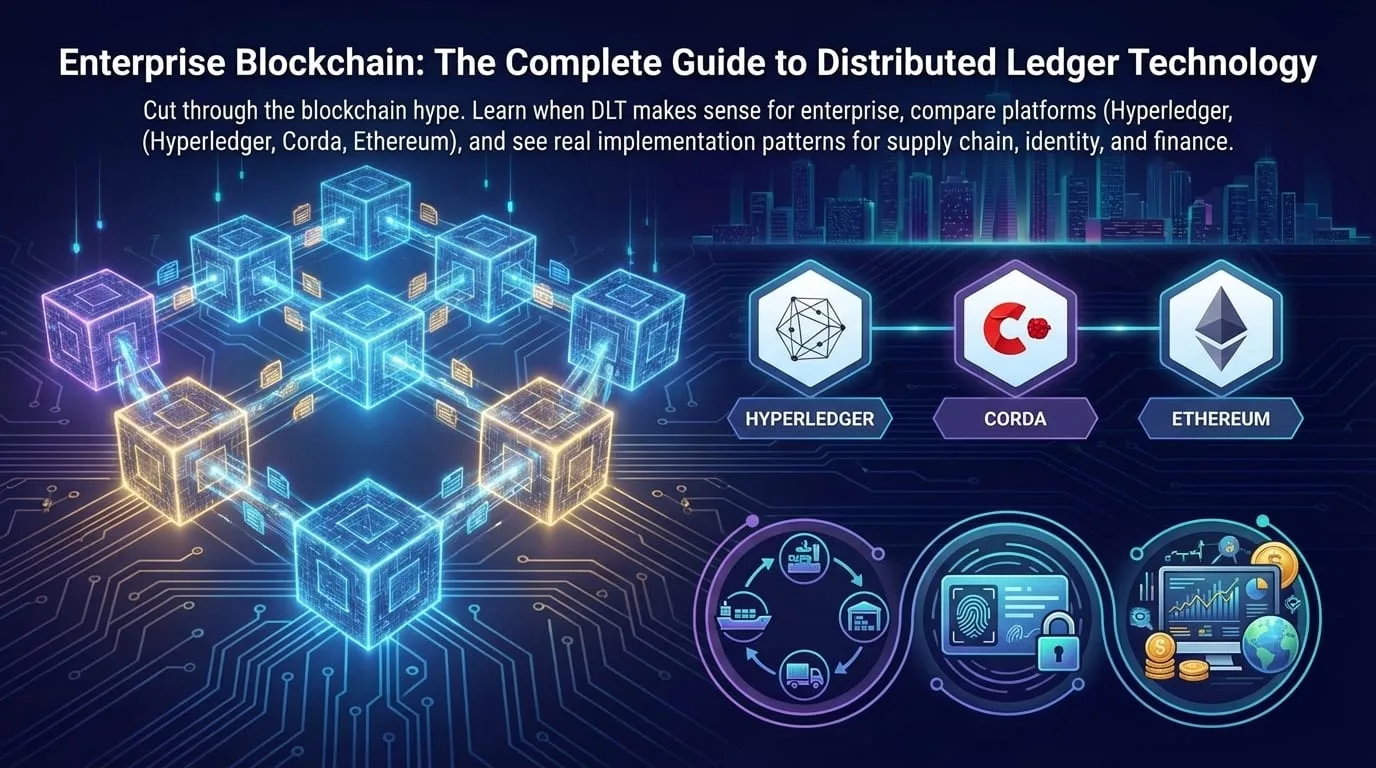
The term "blockchain" often conjures images of volatile cryptocurrencies and NFTs. However, underlying the speculative hype is a powerful technology with significant potential for enterprise applications: Distributed Ledger Technology (DLT).
The question isn't "Should we use blockchain?" but rather "What problem are we solving, and is blockchain the right tool?"
What is Blockchain (DLT)?
At its core, a blockchain is a decentralized, immutable ledger shared among multiple parties.
Blockchain Fundamentals
──────────────────────────────────────────────────────────────────

Block Structure:
┌─────────────────────────────────────────────────────────────────┐
│ Block #42                                                       │
├─────────────────────────────────────────────────────────────────┤
│ Previous Hash: 0x7f3a...                                        │
│ Timestamp: 2024-08-10T14:30:00Z                                 │
│ Merkle Root: 0x8b2c...                                          │
├─────────────────────────────────────────────────────────────────┤
│ Transactions:                                                   │
│   TX1: A → B: Transfer asset #123                               │
│   TX2: C → D: Update record #456                                │
│   TX3: E → F: Create contract #789                              │
├─────────────────────────────────────────────────────────────────┤
│ Hash: 0x9d4e...                                                 │
└─────────────────────────────────────────────────────────────────┘
                           │
                           ▼
┌─────────────────────────────────────────────────────────────────┐
│ Block #43                                                       │
├─────────────────────────────────────────────────────────────────┤
│ Previous Hash: 0x9d4e... (links to Block #42)                   │
│ ...                                                             │
└─────────────────────────────────────────────────────────────────┘

Chain Properties:
├── Immutable: Changing one block invalidates all subsequent blocks
├── Distributed: Every participant has a copy
├── Consensus: All parties agree on state changes
└── Transparent: Audit trail visible to participants
Key Properties
| Property | Description | Business Value |
|---|---|---|
| Decentralization | No single point of control | Reduced counterparty risk |
| Immutability | Records can't be altered | Tamper-proof audit trail |
| Transparency | All parties see same data | Trust without intermediaries |
| Programmability | Smart contracts automate logic | Reduced manual processes |
| Consensus | Agreement without central authority | Multi-party coordination |
When Does Blockchain Make Sense?
Most blockchain projects fail because they apply the technology to problems that don't need it.
Blockchain Decision Framework
──────────────────────────────────────────────────────────────────

Start: Do you need to store data?
       │
       ├── No → Don't use blockchain
       │
       └── Yes → Do multiple parties need to write?
                 │
                 ├── No → Use a database
                 │
                 └── Yes → Do you trust a single party to manage writes?
                           │
                           ├── Yes → Use a database with permissions
                           │
                           └── No → Do parties have conflicting interests?
                                    │
                                    ├── No → Use a shared database
                                    │
                                    └── Yes → Do you need an immutable log?
                                              │
                                              ├── No → Use a database with audit
                                              │
                                              └── Yes → Does a trusted third party exist?
                                                        │
                                                        ├── Yes → Consider third party
                                                        │
                                                        └── No → BLOCKCHAIN may be appropriate


Key Criteria for Blockchain:
├── Multiple untrusting parties
├── Need for shared source of truth
├── No trusted intermediary available
├── Immutability is critical
└── Disintermediation provides value
Good vs. Bad Use Cases
| Good Use Case | Why Blockchain Fits |
|---|---|
| Supply chain provenance | Multiple parties, no single owner, need audit trail |
| Trade finance | Banks don't trust each other, paper processes |
| Cross-border payments | No central authority for international transfers |
| Digital identity | User controls data, verifiable credentials |
| Asset tokenization | Fractional ownership, automated settlement |
| Bad Use Case | Why Blockchain Doesn't Fit |
|---|---|
| Internal record keeping | Single party, just use a database |
| Real-time transactions | Blockchain is slow for high frequency |
| Private data storage | Blockchain is designed for transparency |
| Simple CRUD apps | Over-engineering, no multi-party need |
Enterprise Blockchain Platforms
Platform Comparison
Enterprise Blockchain Platforms
──────────────────────────────────────────────────────────────────

                      Hyperledger    R3 Corda      Ethereum
                         Fabric                   (Private)
                      ──────────    ─────────     ─────────
Type                  Permissioned  Permissioned  Permissioned
                                                  or Public

Consensus             Pluggable     Notary-based  PoA, IBFT
                      (Raft, PBFT)  (Uniqueness)

Smart Contracts       Chaincode     CorDapps      Solidity
                      (Go, JS)      (Kotlin/Java) EVM-compatible

Privacy               Channels      Point-to-     Private
                      Private Data  point by      Transactions
                                    design

Performance           3,000+ TPS    200+ TPS      100-500 TPS
                      (depends on   (with flow)   (depends on
                      consensus)                   consensus)

Best For              Supply chain  Financial     Token/DeFi
                      General       services      General
                      enterprise                  purpose
Hyperledger Fabric
Best for supply chain and general enterprise use cases.
# Hyperledger Fabric Network Configuration
Organizations:
  - Name: Manufacturer
    MSPID: ManufacturerMSP
    Peers:
      - manufacturer-peer0
      - manufacturer-peer1

  - Name: Distributor
    MSPID: DistributorMSP
    Peers:
      - distributor-peer0

  - Name: Retailer
    MSPID: RetailerMSP
    Peers:
      - retailer-peer0

Channels:
  - Name: supply-chain
    Organizations:
      - Manufacturer
      - Distributor
      - Retailer
    Chaincode:
      - Name: product-tracking
        Language: go
        Version: "1.0"

  - Name: private-pricing
    Organizations:
      - Manufacturer
      - Distributor
    # Private channel for sensitive pricing data
R3 Corda
Designed for financial services with point-to-point privacy.
// Corda Smart Contract (CorDapp)
@BelongsToContract(TradeFinanceContract::class)
data class LetterOfCredit(
    val lcNumber: String,
    val amount: Amount<Currency>,
    val issuingBank: Party,
    val advisingBank: Party,
    val applicant: Party,
    val beneficiary: Party,
    val goods: String,
    val expiryDate: Instant,
    val status: LCStatus,
    override val linearId: UniqueIdentifier = UniqueIdentifier()
) : LinearState {

    override val participants: List<AbstractParty>
        get() = listOf(issuingBank, advisingBank, applicant, beneficiary)
}

class TradeFinanceContract : Contract {
    companion object {
        const val ID = "com.example.contract.TradeFinanceContract"
    }

    override fun verify(tx: LedgerTransaction) {
        val command = tx.commands.requireSingleCommand<Commands>()

        when (command.value) {
            is Commands.Issue -> {
                requireThat {
                    "No inputs should be consumed" using (tx.inputs.isEmpty())
                    "One output should be produced" using (tx.outputs.size == 1)
                    val output = tx.outputsOfType<LetterOfCredit>().single()
                    "Amount must be positive" using (output.amount.quantity > 0)
                    "Expiry must be in the future" using
                        (output.expiryDate > Instant.now())
                }
            }
            is Commands.Amend -> { /* validation logic */ }
            is Commands.Pay -> { /* payment validation */ }
        }
    }

    interface Commands : CommandData {
        class Issue : Commands
        class Amend : Commands
        class Pay : Commands
    }
}
Ethereum (Private Networks)
For token-based applications and smart contract flexibility.
// SPDX-License-Identifier: MIT
pragma solidity ^0.8.19;

import "@openzeppelin/contracts/token/ERC721/ERC721.sol";
import "@openzeppelin/contracts/access/AccessControl.sol";

/**
 * @title SupplyChainNFT
 * @dev Track physical goods through supply chain as NFTs
 */
contract SupplyChainNFT is ERC721, AccessControl {
    bytes32 public constant MANUFACTURER_ROLE = keccak256("MANUFACTURER_ROLE");
    bytes32 public constant DISTRIBUTOR_ROLE = keccak256("DISTRIBUTOR_ROLE");
    bytes32 public constant RETAILER_ROLE = keccak256("RETAILER_ROLE");

    struct Product {
        string sku;
        string origin;
        uint256 manufactureDate;
        string[] checkpoints;
        string[] certifications;
        bool recalled;
    }

    mapping(uint256 => Product) public products;
    uint256 private _tokenIdCounter;

    event ProductCreated(uint256 indexed tokenId, string sku, address manufacturer);
    event CheckpointAdded(uint256 indexed tokenId, string location, address party);
    event ProductRecalled(uint256 indexed tokenId, string reason);

    constructor() ERC721("SupplyChainProduct", "SCP") {
        _grantRole(DEFAULT_ADMIN_ROLE, msg.sender);
    }

    function createProduct(
        string memory sku,
        string memory origin,
        string[] memory certifications
    ) external onlyRole(MANUFACTURER_ROLE) returns (uint256) {
        uint256 tokenId = _tokenIdCounter++;
        _safeMint(msg.sender, tokenId);

        products[tokenId] = Product({
            sku: sku,
            origin: origin,
            manufactureDate: block.timestamp,
            checkpoints: new string[](0),
            certifications: certifications,
            recalled: false
        });

        emit ProductCreated(tokenId, sku, msg.sender);
        return tokenId;
    }

    function addCheckpoint(
        uint256 tokenId,
        string memory location
    ) external {
        require(
            hasRole(DISTRIBUTOR_ROLE, msg.sender) ||
            hasRole(RETAILER_ROLE, msg.sender),
            "Unauthorized"
        );
        require(!products[tokenId].recalled, "Product recalled");

        products[tokenId].checkpoints.push(location);
        emit CheckpointAdded(tokenId, location, msg.sender);
    }

    function recallProduct(
        uint256 tokenId,
        string memory reason
    ) external onlyRole(MANUFACTURER_ROLE) {
        products[tokenId].recalled = true;
        emit ProductRecalled(tokenId, reason);
    }

    function getProductHistory(uint256 tokenId)
        external
        view
        returns (Product memory)
    {
        return products[tokenId];
    }

    function supportsInterface(bytes4 interfaceId)
        public
        view
        override(ERC721, AccessControl)
        returns (bool)
    {
        return super.supportsInterface(interfaceId);
    }
}
Enterprise Use Cases Deep Dive
1. Supply Chain Transparency
Supply Chain on Blockchain
──────────────────────────────────────────────────────────────────

Traditional Supply Chain:
┌──────────┐    ┌──────────┐    ┌──────────┐    ┌──────────┐
│ Farmer   │───►│ Processor│───►│Distributor│───►│ Retailer │
└──────────┘    └──────────┘    └──────────┘    └──────────┘
     │               │               │               │
     ▼               ▼               ▼               ▼
┌──────────┐    ┌──────────┐    ┌──────────┐    ┌──────────┐
│ Paper    │    │ Paper    │    │ Paper    │    │ Paper    │
│ Records  │    │ Records  │    │ Records  │    │ Records  │
└──────────┘    └──────────┘    └──────────┘    └──────────┘

Problems:
├── Data silos - each party has own records
├── No visibility - can't trace contamination source
├── Fraud risk - documents can be forged
└── Slow recalls - takes days to trace products


Blockchain-Enabled Supply Chain:
┌──────────┐    ┌──────────┐    ┌──────────┐    ┌──────────┐
│ Farmer   │───►│ Processor│───►│Distributor│───►│ Retailer │
└────┬─────┘    └────┬─────┘    └────┬─────┘    └────┬─────┘
     │               │               │               │
     ▼               ▼               ▼               ▼
┌─────────────────────────────────────────────────────────────┐
│                    Shared Blockchain                         │
│                                                             │
│  Block 1          Block 2          Block 3          Block 4 │
│  ┌─────────┐     ┌─────────┐     ┌─────────┐     ┌─────────┐│
│  │Harvested│────►│Processed│────►│ Shipped │────►│Received ││
│  │Origin:FR│     │Cert:Org │     │Temp:4°C │     │Store:123││
│  └─────────┘     └─────────┘     └─────────┘     └─────────┘│
└─────────────────────────────────────────────────────────────┘

Benefits:
├── Single source of truth - all parties see same data
├── Full traceability - trace in seconds, not days
├── Immutable records - can't be altered after the fact
└── Automated compliance - certifications verified on-chain
2. Digital Identity
// Verifiable Credentials Implementation
interface VerifiableCredential {
  "@context": string[];
  type: string[];
  issuer: string;
  issuanceDate: string;
  credentialSubject: {
    id: string;
    [key: string]: any;
  };
  proof: {
    type: string;
    created: string;
    verificationMethod: string;
    proofPurpose: string;
    proofValue: string;
  };
}

// Example: University Degree Credential
const degreeCredential: VerifiableCredential = {
  "@context": [
    "https://www.w3.org/2018/credentials/v1",
    "https://www.w3.org/2018/credentials/examples/v1",
  ],
  type: ["VerifiableCredential", "UniversityDegreeCredential"],
  issuer: "did:web:university.edu",
  issuanceDate: "2024-06-15T00:00:00Z",
  credentialSubject: {
    id: "did:example:alice",
    degree: {
      type: "BachelorDegree",
      name: "Bachelor of Science in Computer Science",
      graduationDate: "2024-05-20",
    },
  },
  proof: {
    type: "Ed25519Signature2020",
    created: "2024-06-15T12:00:00Z",
    verificationMethod: "did:web:university.edu#key-1",
    proofPurpose: "assertionMethod",
    proofValue: "z58DAdFfa9SkqZMVPxAQpic7...",
  },
};

// Verification Flow
async function verifyCredential(
  credential: VerifiableCredential
): Promise<VerificationResult> {
  // 1. Resolve issuer DID
  const issuerDID = await resolveDID(credential.issuer);

  // 2. Get public key from DID document
  const publicKey = issuerDID.verificationMethod.find(
    (vm) => vm.id === credential.proof.verificationMethod
  );

  // 3. Verify signature
  const isValid = await verifySignature(
    credential,
    publicKey,
    credential.proof.proofValue
  );

  // 4. Check revocation status (on-chain)
  const isRevoked = await checkRevocationRegistry(credential);

  return {
    verified: isValid && !isRevoked,
    issuer: issuerDID,
    checks: {
      signature: isValid,
      revocation: !isRevoked,
      expiration: !isExpired(credential),
    },
  };
}
3. Trade Finance
Letter of Credit on Blockchain
──────────────────────────────────────────────────────────────────

Traditional LC Process (10-14 days):
┌─────────┐    ┌─────────┐    ┌─────────┐    ┌─────────┐
│ Buyer   │───►│ Buyer's │───►│ Seller's│───►│ Seller  │
│         │    │  Bank   │    │  Bank   │    │         │
└─────────┘    └─────────┘    └─────────┘    └─────────┘
     │              │              │              │
     ▼              ▼              ▼              ▼
  Request        Issue LC       Advise LC      Ship Goods
  (Day 1)       (Days 2-3)     (Days 4-5)    (Days 6-7)
                    │              │              │
                    ▼              ▼              ▼
                 Review         Forward        Present
                 Docs          Documents       Documents
               (Days 8-10)    (Days 11-12)   (Days 13-14)

Problems:
├── Paper-based: Physical documents shipped globally
├── Slow: 10-14 days minimum
├── Expensive: 1-3% of transaction value
├── Fraud: Document forgery is common
└── Disputes: Conflicting records


Blockchain LC Process (2-3 days):
┌─────────────────────────────────────────────────────────────┐
│                    Blockchain Network                        │
│                                                             │
│  ┌─────────┐  ┌─────────┐  ┌─────────┐  ┌─────────┐       │
│  │ Buyer   │  │ Buyer's │  │ Seller's│  │ Seller  │       │
│  │         │  │  Bank   │  │  Bank   │  │         │       │
│  └────┬────┘  └────┬────┘  └────┬────┘  └────┬────┘       │
│       │            │            │            │             │
│       ▼            ▼            ▼            ▼             │
│  ┌─────────────────────────────────────────────────────┐   │
│  │              Smart Contract: LC #12345              │   │
│  │                                                     │   │
│  │  State: DOCUMENTS_SUBMITTED                         │   │
│  │  Amount: $500,000                                   │   │
│  │  Goods: 1000 units of Product X                     │   │
│  │  Documents: [Bill of Lading ✓] [Invoice ✓]          │   │
│  │  Conditions: [Weight verified ✓] [Temp verified ✓]  │   │
│  │                                                     │   │
│  │  When all conditions met → Auto-release payment     │   │
│  └─────────────────────────────────────────────────────┘   │
└─────────────────────────────────────────────────────────────┘

Benefits:
├── Digital documents: No paper, no shipping
├── Fast: 2-3 days vs 10-14 days
├── Cheaper: 70% cost reduction
├── Transparent: All parties see same state
└── Automated: Smart contracts execute on conditions
Implementation Challenges
| Challenge | Mitigation |
|---|---|
| Scalability | Use permissioned networks, off-chain data |
| Privacy | Private channels, zero-knowledge proofs |
| Interoperability | Standard APIs, bridge protocols |
| Integration | APIs and adapters to legacy systems |
| Governance | Clear consortium rules, dispute resolution |
| Regulatory | Legal framework for smart contracts |
| Key Management | HSMs, multi-signature schemes |
Privacy Techniques
Privacy-Preserving Blockchain Patterns
──────────────────────────────────────────────────────────────────

1. Private Channels (Hyperledger Fabric)
┌─────────────────────────────────────────────────────────────┐
│                    Main Blockchain                          │
│  [Public transactions visible to all]                       │
└─────────────────────────────────────────────────────────────┘
                           │
        ┌──────────────────┼──────────────────┐
        ▼                  ▼                  ▼
┌───────────────┐  ┌───────────────┐  ┌───────────────┐
│ Private       │  │ Private       │  │ Private       │
│ Channel A     │  │ Channel B     │  │ Channel C     │
│ (Orgs 1,2)    │  │ (Orgs 2,3)    │  │ (Orgs 1,3)    │
└───────────────┘  └───────────────┘  └───────────────┘


2. Zero-Knowledge Proofs
─────────────────────────
Prove a statement is true without revealing the data.

Example: Prove "I am over 21" without revealing DOB
┌─────────────────┐        ┌─────────────────┐
│ User            │        │ Verifier        │
│                 │        │                 │
│ DOB: 1990-05-15 │───────►│ ZK Proof        │
│                 │        │ "Age >= 21": ✓  │
│ (Never shared)  │        │ (DOB unknown)   │
└─────────────────┘        └─────────────────┘


3. Off-Chain Data with On-Chain Hashes
──────────────────────────────────────
┌────────────────────┐
│ Sensitive Document │
│ (Stored off-chain) │
└─────────┬──────────┘
          │ SHA-256 Hash
          ▼
┌────────────────────┐
│ Blockchain         │
│                    │
│ Hash: 0x7a3f...    │
│ Timestamp: ...     │
│ Owner: 0x1234...   │
└────────────────────┘

Proves document existed at time T without revealing content
Key Takeaways
- Blockchain is not a database replacement-it's for multi-party trust
- Use the decision framework-most use cases don't need blockchain
- Permissioned networks dominate enterprise-Hyperledger, Corda, private Ethereum
- Supply chain and finance lead adoption-proven ROI in these domains
- Privacy requires design-channels, ZKPs, off-chain data
- Smart contracts automate trust-but code is law (bugs are expensive)
- Start with a pilot-prove value before scaling
- Governance is critical-technology is easy, consortium rules are hard
Blockchain is a powerful tool for specific problems-multi-party processes where trust is expensive or impossible. For everything else, a database is simpler, faster, and cheaper.
Evaluating blockchain for your enterprise? Contact EGI Consulting for a blockchain feasibility assessment and implementation roadmap tailored to your industry.
Get new articles by email.
One or two a month. No marketing, no forwarding your address. Unsubscribe anytime.