Why 70% of Digital Transformations Fail: Root Causes and How to Succeed
Digital Transformation isn't a technology project-it's an organizational one. Learn the common failure patterns, anti-patterns to avoid, and the strategic framework for successful transformation.
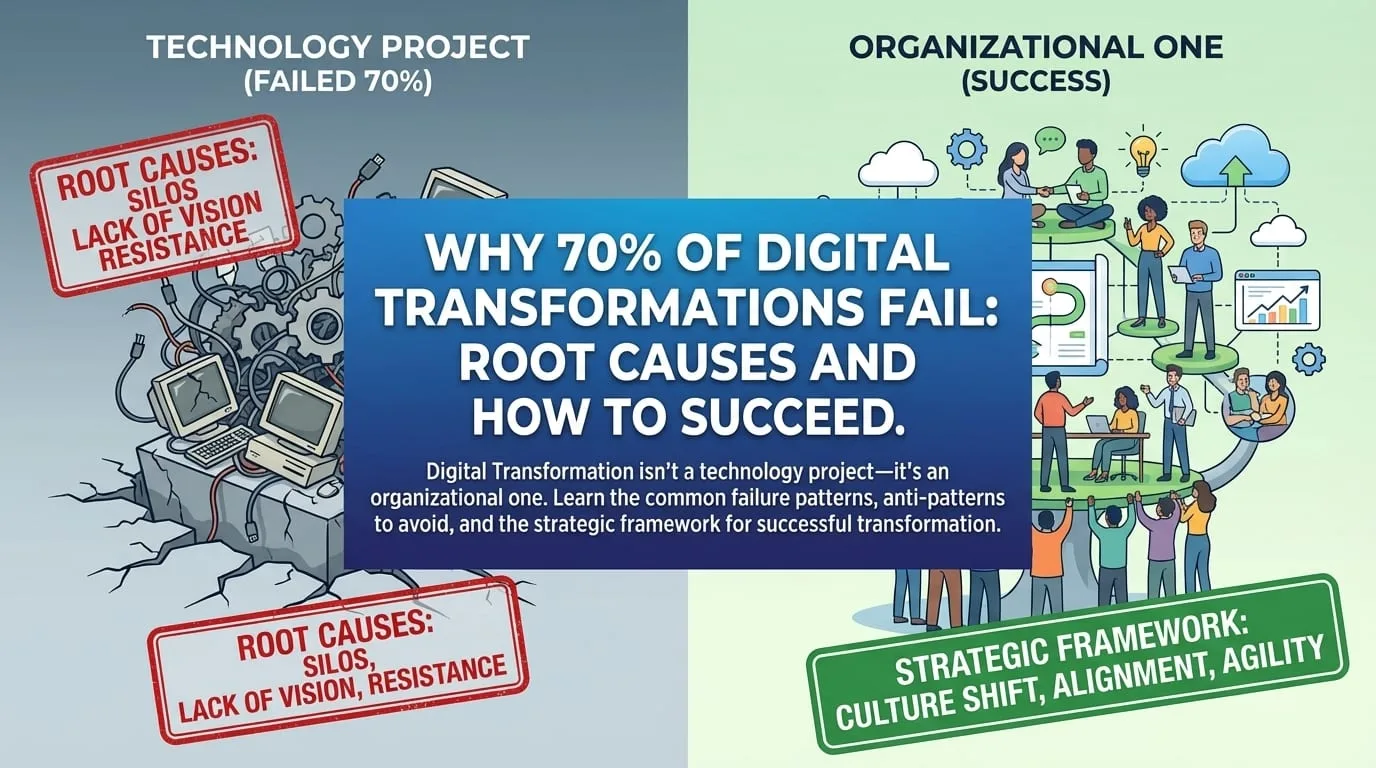
"Digital Transformation" is the most expensive buzzword in business. McKinsey estimates that 70% of these initiatives fail to reach their goals. Boston Consulting Group puts it at 70-80%. Billions of dollars are wasted annually on transformations that deliver little more than frustration and organizational fatigue.
Why? Because most organizations mistake technology adoption for transformation. Buying Salesforce isn't transformation. Moving to AWS isn't transformation. Adopting Agile isn't transformation.
True transformation is about changing how your organization creates and delivers value. Technology is the enabler, not the destination.
The Anatomy of Transformation Failure
Digital Transformation Failure Patterns
──────────────────────────────────────────────────────────────────

                    70% Failure Rate

         ┌────────────────────────────────────────┐
         │                                        │
    ┌────┴────┐  ┌─────────┐  ┌─────────┐  ┌─────┴────┐
    │ Culture │  │ Strategy│  │Execution│  │Technology│
    │  Clash  │  │  Vacuum │  │  Chaos  │  │  Myopia  │
    │         │  │         │  │         │  │          │
    │   25%   │  │   25%   │  │   35%   │  │   15%    │
    └─────────┘  └─────────┘  └─────────┘  └──────────┘

Key Insight: Only 15% of failures are technology problems
The rest are people, strategy, and execution problems
The Four Failure Archetypes
| Archetype | Symptoms | Root Cause |
|---|---|---|
| Culture Clash | Resistance, shadow IT, workarounds | Change imposed, not embraced |
| Strategy Vacuum | Disconnected initiatives, no clear vision | No "why", only "what" |
| Execution Chaos | Scope creep, missed deadlines, budget overruns | Poor governance, unclear ownership |
| Technology Myopia | Shiny object syndrome, integration nightmares | Tools chosen before problems defined |
Failure Mode 1: The "Tech-First" Fallacy
The biggest mistake is treating transformation as a technology project.
Tech-First Thinking (Wrong)
──────────────────────────────────────────────────────────────────

"We need to move to the cloud"
           │
           ▼
    ┌─────────────┐
    │  Lift and   │
    │   Shift     │
    └──────┬──────┘
           │
           ▼
    ┌─────────────────────────────────────────┐
    │ Same processes + Same org structure +   │
    │ Same silos + New infrastructure         │
    │                                         │
    │ = A mess in the cloud instead of        │
    │   a mess on-premises                    │
    └─────────────────────────────────────────┘


Business-First Thinking (Right)
──────────────────────────────────────────────────────────────────

"How can we serve customers 10x better?"
           │
           ▼
    ┌─────────────┐
    │ Customer    │
    │ Journey     │
    │ Analysis    │
    └──────┬──────┘
           │
    ┌──────┴──────┬────────────────┬─────────────────┐
    │             │                │                 │
    ▼             ▼                ▼                 ▼
Process      Team           Technology       Metrics
Changes      Structure      Enablers         & Feedback
    │             │                │                 │
    └─────────────┴────────────────┴─────────────────┘
                           │
                           ▼
              Integrated transformation that
              delivers measurable customer value
Real-World Example: Retail Transformation
Failed Approach:
├── Problem: "Our e-commerce is outdated"
├── Solution: "Implement Shopify Plus"
├── Result: New platform, same fulfillment problems
│           Same inventory sync issues
│           Same organizational silos
└── Outcome: Expensive re-platforming, marginal improvement

Successful Approach:
├── Problem: "Customers wait 7 days for delivery"
├── Analysis: Why?
│   ├── Siloed inventory systems
│   ├── Manual order routing
│   └── Disconnected supply chain
├── Solution: Transform order-to-delivery process
│   ├── Unified inventory visibility
│   ├── Automated smart routing
│   ├── Cross-functional fulfillment team
│   └── Technology to enable above
└── Outcome: 2-day delivery, 40% cost reduction
Failure Mode 2: Lack of Executive Alignment
Transformation without unified executive sponsorship is doomed.
| Executive | Priority | Conflict |
|---|---|---|
| CEO | Speed to market | Wants fast results |
| CFO | Cost reduction | Wants to cut budget |
| CIO | Technical excellence | Wants more time |
| COO | Operational stability | Wants less disruption |
| CMO | Customer experience | Wants more features |
When executives have conflicting goals, the project tears itself apart.
The Alignment Framework
Executive Alignment Requirements
──────────────────────────────────────────────────────────────────

1. Shared Vision
   └── "In 3 years, we will be _____ for our customers"
       Not: "We'll use technology X"
       But: "We'll enable same-day delivery nationwide"

2. Unified Metrics
   └── One dashboard, one truth
       All executives measured on same outcomes
       No hiding behind siloed KPIs

3. Committed Investment
   └── Multi-year funding commitment
       Not: Annual budget fights
       But: Ring-fenced transformation budget

4. Active Participation
   └── Weekly executive steering
       Not: Quarterly updates to ignore
       But: Active blockers resolution

5. Visible Sponsorship
   └── Executives champion the change
       Not: Delegate to "digital team"
       But: CEO speaks at every town hall about it
Failure Mode 3: Siloed Innovation
The "Innovation Lab" anti-pattern:
Innovation Theater (Failure Pattern)
──────────────────────────────────────────────────────────────────

┌─────────────────────────────────────────────────────────────────┐
│                       The Core Business                          │
│                                                                  │
│   Legacy systems │ Established processes │ Risk-averse culture  │
│                                                                  │
│   "We've always done it this way"                               │
│                                                                  │
│                     THE WALL                                     │
├─────────────────────────────────────────────────────────────────┤
│                       Innovation Lab                             │
│                                                                  │
│   ┌─────────┐  ┌─────────┐  ┌─────────┐                        │
│   │ Cool    │  │ New     │  │ Hipster │                        │
│   │ Demo #1 │  │ Tech #2 │  │ Office  │                        │
│   └─────────┘  └─────────┘  └─────────┘                        │
│                                                                  │
│   "Look what we built!" (that can never integrate)              │
│                                                                  │
└─────────────────────────────────────────────────────────────────┘

Result:
├── Lab builds exciting demos
├── Core business rejects "immune response"
├── Nothing changes
├── Lab team leaves in frustration
└── Organization claims "innovation failed"
The Integration-First Approach
| Instead Of | Do This |
|---|---|
| Separate innovation lab | Embedded product teams in business units |
| Cool demos | Minimum viable products in production |
| New technology stacks | Evolutionary architecture improvements |
| "Build and throw over wall" | Business and tech in same team |
| 6-month cycles | 2-week iterations with real users |
Failure Mode 4: Ignoring Culture
You cannot install Agile into a command-and-control hierarchy.
Culture Debt
──────────────────────────────────────────────────────────────────

Surface Changes                Hidden Cultural Blockers
─────────────────              ──────────────────────────
✓ Jira boards                  × 5 levels of approval
✓ Daily standups               × Fear of failure punished
✓ Sprint planning              × "Whose fault is this?"
✓ Retrospectives               × Blame culture
✓ Cross-functional teams       × Functional silos still exist
                               × Incentives reward individual, not team
                               × Managers micromanage

Result: Agile ceremony, waterfall reality
The Culture Change Playbook
Culture Change Levers
──────────────────────────────────────────────────────────────────

1. Model from the Top
   └── Leaders must visibly change first
       "If the CEO still asks for 50-page slide decks,
        Agile is dead on arrival"

2. Change the Incentives
   └── People do what they're measured on
       Old: Individual performance reviews
       New: Team outcome-based rewards

3. Remove Blockers
   └── Identify the "antibodies"
       People whose job is to say "no"
       Either change their role or move them

4. Celebrate New Behaviors
   └── Tell stories of the new way
       "Remember when we shipped in 2 weeks?"
       Make heroes of the change agents

5. Tolerate Productive Failure
   └── "What did we learn?"
       Not: "Who's responsible?"
       Blameless postmortems, not witch hunts
The Success Framework
Organizations that succeed follow a different playbook.
Step 1: Start with the Customer
Customer-Back Problem Definition
──────────────────────────────────────────────────────────────────

Ask:
├── What does the customer want that they can't get today?
├── What friction do they experience?
├── What would make them choose us over competitors?
└── What would make them rave to others?

Not:
├── What technology should we buy?
├── What are our competitors doing?
└── What's trendy in the industry?

Example:
├── Bad: "We need to implement AI"
├── Good: "Customers want instant answers without waiting on hold"
│         → Maybe AI helps, maybe better processes help,
│            maybe better training helps
└── Let the problem define the solution
Step 2: Define Measurable Outcomes
OKR Framework for Transformation
──────────────────────────────────────────────────────────────────

Objective: Become the fastest insurer in claim resolution

Key Results (measurable, time-bound):
├── KR1: Reduce average claim resolution from 14 days to 3 days
├── KR2: Increase customer satisfaction score from 65 to 85
├── KR3: Reduce cost per claim by 40%
└── KR4: Enable 80% of claims to be processed without human intervention

NOT:
├── "Implement claims management system" (activity, not outcome)
├── "Modernize our technology" (vague)
└── "Become more agile" (unmeasurable)
Step 3: Empower Cross-Functional Teams
Team Topology for Transformation
──────────────────────────────────────────────────────────────────

Old Model (Functional Silos):
┌─────────┐  ┌─────────┐  ┌─────────┐  ┌─────────┐
│   IT    │  │Marketing│  │  Ops    │  │ Product │
│         │  │         │  │         │  │         │
│ (builds)│→ │(requests)→ │(operates)→ │(defines) │
└─────────┘  └─────────┘  └─────────┘  └─────────┘
     ▲            │            │            │
     └────────────┴────────────┴────────────┘
              Handoffs, delays, blame

New Model (Cross-Functional Product Teams):
┌───────────────────────────────────────────────────────────────┐
│                    Product Team: Claims                       │
│                                                               │
│  Product Owner + Engineers + Designers + Ops + Business SME  │
│                                                               │
│  Owns the outcome end-to-end                                 │
│  Can deploy to production independently                       │
│  Single backlog, single team, single goal                    │
└───────────────────────────────────────────────────────────────┘
Step 4: Iterate and Learn
Iterative Value Delivery
──────────────────────────────────────────────────────────────────

Traditional Approach (High Risk):
─────────────────────────────────────────────────────────────────►
                    18-month project
                         │
                         ▼
                   ┌─────────────┐
                   │ Big Bang    │
                   │ Launch      │
                   │ (Fingers    │
                   │ crossed)    │
                   └─────────────┘


Iterative Approach (De-risked):
─────────────────────────────────────────────────────────────────►
│ Sprint 1 │ Sprint 2 │ Sprint 3 │ Sprint 4 │ ...
     │          │          │          │
     ▼          ▼          ▼          ▼
   MVP 1     Learn      Iterate   Expand
   (10%      adjust     improve   (80%
   users)               (30%      users)
                        users)

Each iteration:
├── Delivers real value
├── Gets real feedback
├── Adjusts direction
└── Reduces risk
The Transformation Operating Model
Transformation Governance Structure
──────────────────────────────────────────────────────────────────

             ┌───────────────────────────────────┐
             │      Executive Steering           │
             │      (Weekly, 30 minutes)         │
             │                                   │
             │  • Remove blockers                │
             │  • Make investment decisions      │
             │  • Align conflicting priorities   │
             └───────────────┬───────────────────┘
                             │
             ┌───────────────┴───────────────────┐
             │    Transformation Office (PMO)    │
             │                                   │
             │  • Track progress against OKRs    │
             │  • Coordinate dependencies        │
             │  • Manage risks and issues        │
             └───────────────┬───────────────────┘
                             │
        ┌────────────────────┼────────────────────┐
        │                    │                    │
        ▼                    ▼                    ▼
┌───────────────┐    ┌───────────────┐    ┌───────────────┐
│  Product Team │    │  Product Team │    │  Product Team │
│   Claims      │    │   Onboarding  │    │   Billing     │
│               │    │               │    │               │
│ (Autonomous)  │    │ (Autonomous)  │    │ (Autonomous)  │
└───────────────┘    └───────────────┘    └───────────────┘
Common Anti-Patterns to Avoid
| Anti-Pattern | Why It Fails | Better Approach |
|---|---|---|
| Boiling the ocean | Too much scope, analysis paralysis | Start small, prove value, expand |
| Transformation theater | Reports without results | Demo working software, not slides |
| Vendor-led transformation | Their incentive is selling, not outcomes | Own your strategy, use vendors tactically |
| "Burn the bridges" | Forcing change creates resistance | Show the new way is better, make old way harder |
| One-size-fits-all | Every team forced into same mold | Principles consistent, practices adapted |
| Declaring victory early | Ship once, move on | Continuous improvement is the goal |
Measuring Transformation Success
| Metric Category | Metrics | Warning Signs |
|---|---|---|
| Customer | NPS, CSAT, retention | No improvement in 6 months |
| Speed | Lead time, deployment frequency | Getting slower, not faster |
| Quality | Error rates, incidents | Reliability declining |
| Efficiency | Cost per transaction, automation % | Costs rising without value |
| Culture | Employee engagement, eNPS | Talent exodus |
| Outcomes | Revenue, market share | Flat despite investment |
Key Takeaways
- Transformation is organizational change, not a technology project
- Start with customer value, work backward to technology
- Executive alignment is non-negotiable-unified vision and metrics
- Kill the innovation lab-embed innovation in the business
- Culture eats strategy for breakfast-change incentives and behaviors
- Empower cross-functional teams with outcome ownership
- Iterate in small batches-deliver value early and often
- Transformation never ends-it becomes continuous evolution
Digital transformation is not a destination-it's a continuous state of evolution. The organizations that succeed are those that embrace change as a core capability, not a one-time project.
Struggling with your digital transformation? Contact EGI Consulting for a transformation assessment and strategic roadmap that addresses the organizational, cultural, and technical dimensions of lasting change.
Keep reading
All articles
From Project to Product: A Complete Guide to Transforming Digital Delivery for the Modern Enterprise
MVP vs Prototype vs Proof of Concept: How to Choose the Right Validation Approach
Building a Data-Driven Culture: A Complete Framework for Organizational Transformation
Get new articles by email.
One or two a month. No marketing, no forwarding your address. Unsubscribe anytime.