Native vs. Cross-Platform in 2026: A Decision Framework for Enterprise Mobile
React Native, Flutter, or fully native: the right answer depends on variables most teams never write down. A framework for making the call once, deliberately, instead of by default.

The native-versus-cross-platform debate has been running for over a decade, and most teams still resolve it the same way: whoever's loudest in the kickoff meeting picks the stack, and the decision gets justified after the fact. That's a bad way to make a decision that's expensive to reverse once you've shipped to production and have real users on both platforms.
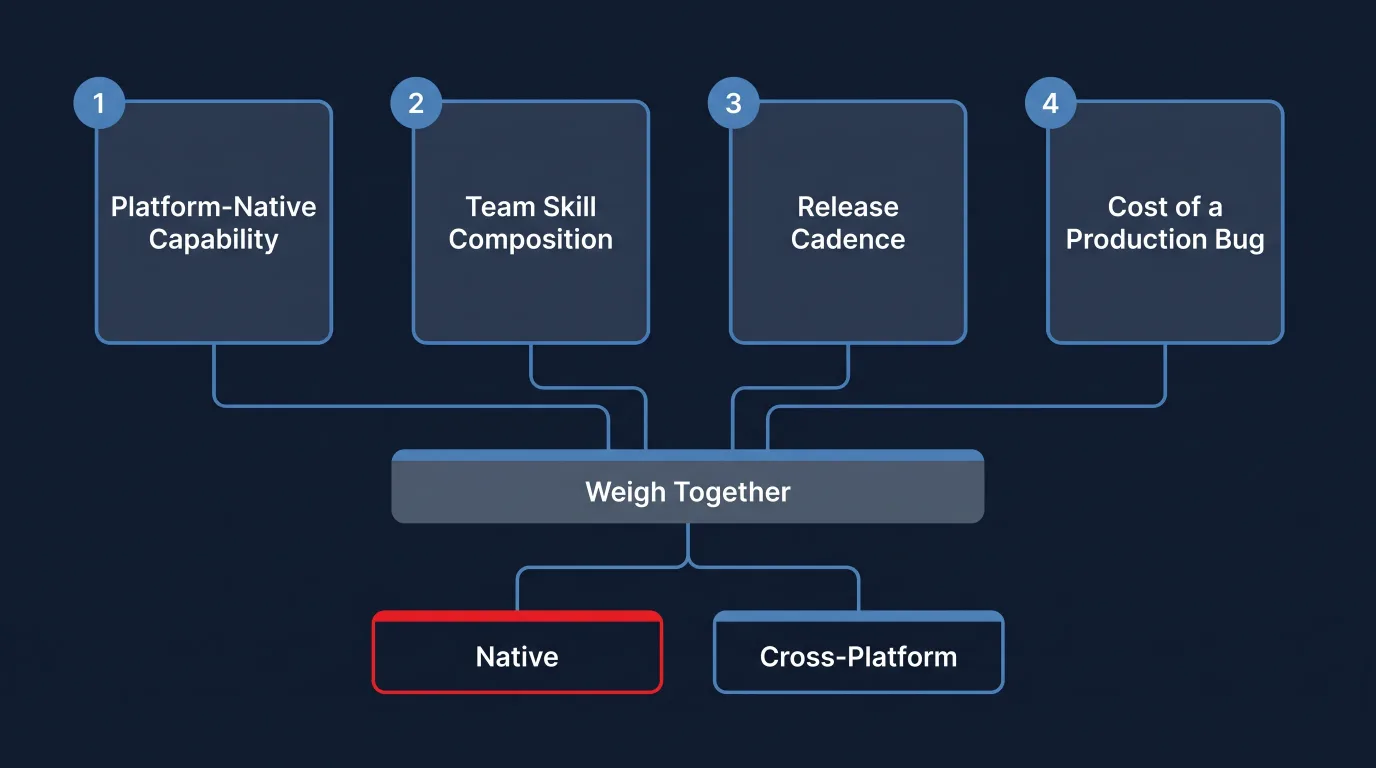
The honest answer is that there isn't a universally right choice. There's a right choice for your specific combination of team, timeline, and product requirements, and it changes depending on four variables most teams never actually write down.
The Four Variables That Actually Decide This
1. How much of your value is in platform-native capability?
If your app is fundamentally a form, a feed, or a dashboard, ARKit, Core Bluetooth, Camera2, and background processing edge cases barely matter. If your app's core value depends on deep camera control, offline-first sync with conflict resolution, background location, or hardware integration, cross-platform frameworks make you fight the abstraction layer for exactly the features that differentiate your product. That fight gets worse, not better, over time as the platforms diverge.
2. What's your team's actual skill composition today?
Cross-platform frameworks are frequently pitched as "hire once, ship twice." In practice, non-trivial apps still need someone who understands each native platform, because you will hit a bug, a store review rejection, or a performance issue that only shows up on one OS. The question isn't whether you can avoid native expertise entirely; it's whether you have one senior generalist who can go deep on both platforms when it's needed, versus needing two fully staffed native teams from day one.
3. What's your actual release cadence requirement?
Cross-platform's biggest honest advantage isn't cost, it's velocity: one codebase means one place to fix a bug, one design system to maintain, one CI pipeline. If you're shipping weekly and iterating on product-market fit, that velocity compounds fast. If you're shipping quarterly to a regulated enterprise audience where each release goes through a formal QA and compliance cycle anyway, the velocity advantage matters less, and the native performance and platform-fidelity advantages matter more.
4. What's the actual cost of a platform-specific bug reaching production?
For a consumer app, a rough edge on Android is an annoying review. For a field-service app used by technicians in the middle of a job, or a clinical app used by a nurse mid-shift, a platform-specific bug is an operational incident. The higher the cost of a defect reaching a real user, the more that argues for native, where you're debugging one platform's real behavior instead of an abstraction layer's approximation of two.
A Framework, Not a Verdict
| Your situation | Lean toward |
|---|---|
| Content/forms/dashboard-heavy app, small team, fast iteration needed | Cross-platform (React Native or Flutter) |
| Deep hardware/sensor integration is the product | Native (Swift/Kotlin) |
| Enterprise internal tool, quarterly releases, compliance-gated QA | Native, or cross-platform with a native specialist on call |
| Consumer app racing to product-market fit | Cross-platform |
| Field/clinical/safety-critical mobile use | Native |
| Team is 1-2 mobile engineers total | Cross-platform, so one person can own both platforms |
Notice what's not on this table: "which framework is more modern" or "which one has better marketing." Those are the two reasons teams most often get this decision wrong, because they're optimizing for how the decision looks in a hiring post instead of what it costs to operate for the next three years.
React Native vs. Flutter, If You've Landed on Cross-Platform
If the framework above points you toward cross-platform, the React Native versus Flutter choice is a smaller, more tactical decision:
- React Native wins when your team already has strong React/TypeScript depth on the web side. The mental model, and a meaningful amount of business logic, can transfer directly.
- Flutter wins when you want more visual consistency out of the box and don't have an existing React investment to leverage. Dart is an easy language to pick up, but it's a second language your team now maintains regardless.
Neither one eliminates the need for a native specialist entirely. Budget for that person from the start rather than discovering the gap during your first App Store rejection.
The Mistake That Costs the Most Later
The single most expensive mistake in enterprise mobile isn't picking the "wrong" framework. It's picking a framework without writing down why, so that eighteen months later, when the team has doubled and half of them weren't in the original room, nobody can evaluate whether the original tradeoffs still hold. Write the decision down as an actual decision record: the four variables above, your answers, and the date. It costs twenty minutes now and saves a re-litigation fight later.
Key takeaways:
- There's no universally correct answer, only a correct answer for your specific hardware dependency, team shape, release cadence, and defect cost.
- Cross-platform's real advantage is velocity from one codebase, not cost savings from fewer engineers, those are not the same thing.
- Budget for a native specialist even on a cross-platform stack. You will need one.
- Write the decision down. The team that revisits it in two years won't have been in the room when it was made.
If you're weighing this decision for a real product, not a hypothetical one, book a discovery session and we'll work through your specific four variables together.



Get new articles by email.
One or two a month. No marketing, no forwarding your address. Unsubscribe anytime.