Event-Driven Architecture: Building Resilient, Scalable Systems with EDA
Synchronous HTTP calls create fragile systems. Learn how Event-Driven Architecture with Kafka, RabbitMQ, and cloud messaging enables loose coupling, resilience, and infinite scalability.
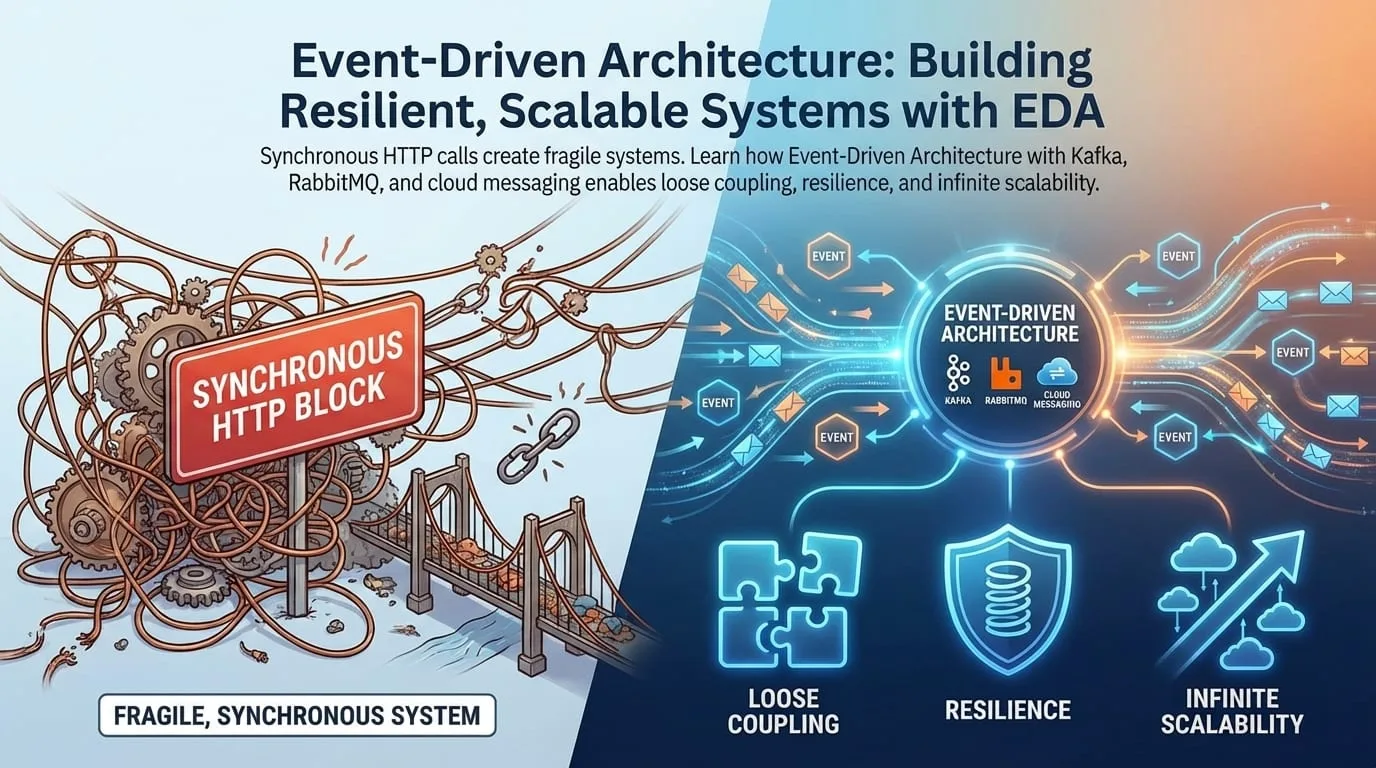
In a traditional microservices architecture, Service A calls Service B, which calls Service C. If Service C is slow, the entire chain hangs. If Service C is down, the request fails. This is tight coupling-and it creates fragile, hard-to-scale systems.
Event-Driven Architecture (EDA) inverts this model. Instead of "do this," services say "this happened." The difference is profound.
The Problem with Request-Response
Traditional Request-Response (Synchronous)
──────────────────────────────────────────────────────────────────

User ──► Order Service ──► Inventory Service ──► Payment Service
                    │              │                    │
                    └──── WAITS ───┴────── WAITS ──────┘

If Payment Service is slow (5s):
├── Inventory Service blocks for 5s
├── Order Service blocks for 5s
└── User waits 10+ seconds total

If Inventory Service is DOWN:
├── Order Service gets timeout/error
├── User sees failure
└── Order is lost
Problems with synchronous architecture:
| Issue | Impact |
|---|---|
| Cascading Failures | One slow service brings down the chain |
| Tight Coupling | Services must know each other's APIs |
| Scaling Bottlenecks | Downstream services limit throughput |
| Lost Transactions | Failures lose in-flight requests |
| Hard to Extend | Adding consumers requires code changes |
Event-Driven Architecture: A Different Paradigm
With EDA, services communicate through events-immutable facts about what happened:
Event-Driven Architecture
──────────────────────────────────────────────────────────────────

                        ┌─────────────────┐
                        │  Message Broker │
                        │ (Kafka/RabbitMQ)│
                        └────────┬────────┘
                                 │
        ┌────────────────────────┼────────────────────────┐
        │                        │                        │
        ▼                        ▼                        ▼
┌───────────────┐       ┌───────────────┐       ┌───────────────┐
│   Inventory   │       │    Payment    │       │     Email     │
│   Service     │       │    Service    │       │    Service    │
│               │       │               │       │               │
│ "Reserve      │       │ "Process      │       │ "Send order   │
│  Stock"       │       │  Payment"     │       │  confirmation"│
└───────────────┘       └───────────────┘       └───────────────┘

Order Service publishes: OrderPlaced { orderId, items, customerId }
├── Order Service doesn't wait
├── Order Service doesn't know who listens
└── Each consumer processes independently
Choreography vs. Orchestration
There are two patterns for coordinating events across services:
Choreography: Decentralized Dance
Each service reacts to events and publishes its own events. No central coordinator.
Choreography Pattern
──────────────────────────────────────────────────────────────────

OrderPlaced ──► Inventory Service ──► StockReserved
                                            │
StockReserved ──► Payment Service ──► PaymentProcessed
                                            │
PaymentProcessed ──► Shipping Service ──► ShipmentCreated
                                            │
ShipmentCreated ──► Email Service ──► NotificationSent

Each service:
├── Listens for events it cares about
├── Does its work
└── Publishes outcome events
Pros:
- Loose coupling-services are truly independent
- Easy to add new consumers
- No single point of failure
Cons:
- Hard to see the full workflow
- Debugging requires tracing across services
- Saga patterns needed for failures
Orchestration: Central Conductor
A central orchestrator coordinates the workflow:
Orchestration Pattern
──────────────────────────────────────────────────────────────────

                    ┌──────────────────┐
                    │   Order Saga     │
                    │  Orchestrator    │
                    └────────┬─────────┘
                             │
         ┌───────────────────┼───────────────────┐
         ▼                   ▼                   ▼
   Reserve Stock      Process Payment     Create Shipment
         │                   │                   │
         └───────────────────┴───────────────────┘
                             │
                    Results back to orchestrator
                             │
                    Orchestrator decides next step
Pros:
- Workflow is visible in one place
- Easier to understand and debug
- Compensating actions are clear
Cons:
- Orchestrator is a coupling point
- Single point of failure risk
- Can become a bottleneck
When to Use Each
| Use Case | Pattern |
|---|---|
| Simple notification flows | Choreography |
| Many consumers for same event | Choreography |
| Complex business transactions | Orchestration |
| Strict ordering requirements | Orchestration |
| Regulatory audit trails | Orchestration |
Implementing EDA with Apache Kafka
Kafka is the industry standard for high-throughput event streaming:
Kafka Architecture
Kafka Cluster Architecture
──────────────────────────────────────────────────────────────────

Producer A ──┐                              ┌── Consumer Group 1
Producer B ──┼──► Topic: orders             │   ├── Consumer 1a
Producer C ──┘    ├── Partition 0 ──────────┼── Consumer 1b
                  ├── Partition 1 ──────────┤
                  └── Partition 2 ──────────┘
                                            └── Consumer Group 2
                                                ├── Consumer 2a
                                                └── Consumer 2b

Key Concepts:
├── Topics: Named streams of events
├── Partitions: Enable parallelism (events ordered within partition)
├── Consumer Groups: Enable scaling consumers
└── Retention: Events persisted for replay
Kafka Producer Example (TypeScript)
import { Kafka, Partitioners } from "kafkajs";

const kafka = new Kafka({
  clientId: "order-service",
  brokers: ["kafka1:9092", "kafka2:9092"],
});

const producer = kafka.producer({
  createPartitioner: Partitioners.DefaultPartitioner,
});

interface OrderPlacedEvent {
  eventId: string;
  eventType: "OrderPlaced";
  timestamp: string;
  payload: {
    orderId: string;
    customerId: string;
    items: Array<{ productId: string; quantity: number; price: number }>;
    total: number;
  };
}

async function publishOrderPlaced(order: Order): Promise<void> {
  const event: OrderPlacedEvent = {
    eventId: crypto.randomUUID(),
    eventType: "OrderPlaced",
    timestamp: new Date().toISOString(),
    payload: {
      orderId: order.id,
      customerId: order.customerId,
      items: order.items,
      total: order.total,
    },
  };

  await producer.send({
    topic: "orders",
    messages: [
      {
        key: order.id, // Ensures all events for same order go to same partition
        value: JSON.stringify(event),
        headers: {
          "content-type": "application/json",
          "event-type": "OrderPlaced",
        },
      },
    ],
  });

  console.log(`Published OrderPlaced event for order ${order.id}`);
}
Kafka Consumer Example (TypeScript)
import { Kafka, EachMessagePayload } from "kafkajs";

const kafka = new Kafka({
  clientId: "inventory-service",
  brokers: ["kafka1:9092", "kafka2:9092"],
});

const consumer = kafka.consumer({
  groupId: "inventory-service-group",
});

async function startConsumer(): Promise<void> {
  await consumer.connect();
  await consumer.subscribe({
    topic: "orders",
    fromBeginning: false,
  });

  await consumer.run({
    eachMessage: async ({ topic, partition, message }: EachMessagePayload) => {
      const eventType = message.headers?.["event-type"]?.toString();

      if (eventType === "OrderPlaced") {
        const event: OrderPlacedEvent = JSON.parse(message.value!.toString());
        await handleOrderPlaced(event);
      }
    },
  });
}

async function handleOrderPlaced(event: OrderPlacedEvent): Promise<void> {
  const { orderId, items } = event.payload;

  try {
    // Reserve inventory
    for (const item of items) {
      await reserveStock(item.productId, item.quantity);
    }

    // Publish success event
    await publishEvent("StockReserved", { orderId, items });
  } catch (error) {
    // Publish failure event
    await publishEvent("StockReservationFailed", {
      orderId,
      reason: error.message,
    });
  }
}
Event Schemas and Versioning
As systems evolve, event schemas change. Handle this gracefully:
Schema Design Best Practices
// Event envelope pattern
interface EventEnvelope<T> {
  // Metadata
  eventId: string;
  eventType: string;
  schemaVersion: number;
  timestamp: string;
  correlationId?: string;
  causationId?: string;

  // Payload
  payload: T;
}

// Strongly-typed events
interface OrderPlacedV1 {
  orderId: string;
  customerId: string;
  total: number;
}

interface OrderPlacedV2 {
  orderId: string;
  customerId: string;
  total: number;
  currency: string; // Added in V2
  shippingAddress: Address; // Added in V2
}

// Consumer that handles both versions
function handleOrderPlaced(envelope: EventEnvelope<unknown>): void {
  switch (envelope.schemaVersion) {
    case 1:
      const v1 = envelope.payload as OrderPlacedV1;
      processOrderV1(v1);
      break;
    case 2:
      const v2 = envelope.payload as OrderPlacedV2;
      processOrderV2(v2);
      break;
    default:
      throw new Error(`Unknown schema version: ${envelope.schemaVersion}`);
  }
}
Schema Registry (Avro/JSON Schema)
# Using Confluent Schema Registry
version: 1
namespace: com.example.orders
type: record
name: OrderPlaced
fields:
  - name: orderId
    type: string
  - name: customerId
    type: string
  - name: total
    type: double
  - name: currency
    type: string
    default: "USD" # Backward compatible - new field with default
Saga Pattern: Handling Distributed Transactions
When a business process spans multiple services, you need sagas:
Order Saga - Happy Path
──────────────────────────────────────────────────────────────────

OrderPlaced
    │
    ├──► Reserve Inventory ──► StockReserved
    │                              │
    └──────────────────────────────┼──► Process Payment ──► PaymentProcessed
                                   │                            │
                                   └────────────────────────────┼──► Ship Order
                                                                │
                                                           OrderCompleted

Order Saga - Compensating Actions (Payment Failed)
──────────────────────────────────────────────────────────────────

OrderPlaced
    │
    ├──► Reserve Inventory ──► StockReserved
    │                              │
    └──────────────────────────────┼──► Process Payment ──► PaymentFailed
                                   │                            │
                                   │                      ◄─────┘
                                   │
                                   └──► Release Inventory (Compensation)
                                               │
                                         OrderCancelled
Saga Implementation
// Saga orchestrator example
class OrderSaga {
  private state:
    | "PENDING"
    | "STOCK_RESERVED"
    | "PAYMENT_PROCESSED"
    | "COMPLETED"
    | "CANCELLED";

  async execute(order: Order): Promise<void> {
    try {
      // Step 1: Reserve Stock
      this.state = "PENDING";
      await this.reserveStock(order);
      this.state = "STOCK_RESERVED";

      // Step 2: Process Payment
      await this.processPayment(order);
      this.state = "PAYMENT_PROCESSED";

      // Step 3: Create Shipment
      await this.createShipment(order);
      this.state = "COMPLETED";
    } catch (error) {
      await this.compensate(order, error);
    }
  }

  private async compensate(order: Order, error: Error): Promise<void> {
    console.log(`Saga failed at state ${this.state}: ${error.message}`);

    // Compensate in reverse order
    switch (this.state) {
      case "PAYMENT_PROCESSED":
        await this.refundPayment(order);
      // Fall through
      case "STOCK_RESERVED":
        await this.releaseStock(order);
      // Fall through
      case "PENDING":
        await this.cancelOrder(order, error.message);
    }

    this.state = "CANCELLED";
  }
}
CQRS: Command Query Responsibility Segregation
EDA pairs naturally with CQRS-separate models for writes and reads:
CQRS Architecture
──────────────────────────────────────────────────────────────────

Commands (Writes)                      Queries (Reads)
─────────────────                      ────────────────

┌──────────────┐                      ┌──────────────┐
│  Create      │                      │  Get User    │
│  Update      │                      │  List Orders │
│  Delete      │                      │  Search      │
└──────┬───────┘                      └──────┬───────┘
       │                                     │
       ▼                                     ▼
┌──────────────┐                      ┌──────────────┐
│   Command    │                      │   Query      │
│   Handler    │                      │   Handler    │
└──────┬───────┘                      └──────┬───────┘
       │                                     │
       ▼                                     ▼
┌──────────────┐   Events            ┌──────────────┐
│  Write Model │ ──────────────────► │  Read Model  │
│  (Postgres)  │                      │(Elasticsearch)│
└──────────────┘                      └──────────────┘

Benefits:
├── Optimize read model for specific queries
├── Scale reads and writes independently
├── Different storage engines per use case
└── Event sourcing naturally fits
Challenges and Solutions
Challenge 1: Eventual Consistency
Problem: The user sees "Order Placed" before inventory is actually reserved.
Solutions:
// Option 1: Optimistic UI with status updates
interface Order {
  id: string;
  status: "pending" | "confirmed" | "processing" | "shipped";
  lastUpdated: Date;
}

// UI shows: "Order received! We'll confirm availability shortly."
// Subsequent events update status

// Option 2: Wait for critical confirmations
async function placeOrder(order: Order): Promise<OrderResponse> {
  // Publish event
  await publishEvent("OrderPlaced", order);

  // Wait for stock confirmation (with timeout)
  const confirmation = await waitForEvent(
    "StockReserved",
    { orderId: order.id },
    { timeout: 5000 }
  );

  if (confirmation.success) {
    return { status: "confirmed", orderId: order.id };
  } else {
    return { status: "failed", reason: "Out of stock" };
  }
}
Challenge 2: Debugging Distributed Flows
Problem: Tracing a transaction that hops through 5 queues is hard.
Solution: Distributed tracing with correlation IDs:
// Correlation ID propagation
interface EventContext {
  correlationId: string; // Same across entire flow
  causationId: string; // ID of event that caused this one
  spanId: string; // For OpenTelemetry integration
}

async function publishEvent<T>(
  type: string,
  payload: T,
  context: EventContext
): Promise<void> {
  const event = {
    eventId: crypto.randomUUID(),
    eventType: type,
    correlationId: context.correlationId,
    causationId: context.causationId,
    timestamp: new Date().toISOString(),
    payload,
  };

  // Also emit to OpenTelemetry
  tracer.startSpan(type, {
    attributes: { correlationId: context.correlationId },
  });

  await producer.send({
    topic: getTopicForEvent(type),
    messages: [{ value: JSON.stringify(event) }],
  });
}
Challenge 3: Message Ordering
Problem: Events arrive out of order.
Solution: Partition keys and idempotent consumers:
// Same partition = same order
await producer.send({
  topic: "orders",
  messages: [
    {
      key: order.id, // All events for this order go to same partition
      value: JSON.stringify(event),
    },
  ],
});

// Idempotent consumer
async function handleEvent(event: Event): Promise<void> {
  // Check if already processed
  const processed = await redis.get(`processed:${event.eventId}`);
  if (processed) {
    console.log(`Skipping duplicate event ${event.eventId}`);
    return;
  }

  // Process event
  await processEvent(event);

  // Mark as processed (with TTL for cleanup)
  await redis.setex(`processed:${event.eventId}`, 86400, "true");
}
Challenge 4: Dead Letter Queues
Problem: What happens when events can't be processed?
Solution: Dead letter queues with retry logic:
// Kafka consumer with DLQ
await consumer.run({
  eachMessage: async ({ message }) => {
    try {
      await handleMessage(message);
    } catch (error) {
      const retryCount = getRetryCount(message);

      if (retryCount < MAX_RETRIES) {
        // Retry with backoff
        await publishToRetryTopic(message, retryCount + 1);
      } else {
        // Move to dead letter queue
        await publishToDLQ(message, error);
        alertOps(`Message failed after ${MAX_RETRIES} retries`, message);
      }
    }
  },
});
When to Use EDA (and When Not To)
| Scenario | EDA? | Why |
|---|---|---|
| High-volume event processing | ✅ Yes | Scales horizontally, handles bursts |
| Loose coupling needed | ✅ Yes | Services don't need to know each other |
| Real-time notifications | ✅ Yes | Push-based, low latency |
| Simple CRUD operations | ❌ No | Overkill, adds complexity |
| Strong consistency required | ⚠️ Maybe | Sagas add complexity |
| Audit/replay requirements | ✅ Yes | Event log is natural audit trail |
| Team autonomy | ✅ Yes | Teams can deploy independently |
Key Takeaways
- EDA decouples services through asynchronous event communication
- Choreography is simpler but harder to trace; orchestration is more visible but creates coupling
- Kafka is ideal for high-throughput, replayable event streams
- Schema versioning is critical for evolving systems
- Saga patterns handle distributed transactions with compensating actions
- CQRS pairs naturally with EDA for optimized read/write models
- Eventual consistency requires UI/UX patterns to handle uncertainty
- Distributed tracing with correlation IDs is essential for debugging
Event-Driven Architecture isn't a silver bullet-it's a powerful tool that requires a shift in mindset from "Request/Response" to "Publish/Subscribe." When applied correctly, it enables systems that are resilient, scalable, and extensible.
Planning to adopt Event-Driven Architecture? Contact EGI Consulting for architecture reviews, technology selection, and hands-on implementation guidance for Kafka, RabbitMQ, and cloud-native messaging systems.
Keep reading
All articles
Microservices vs. Monoliths: A Complete Guide to Making the Right Architectural Choice in 2024
GraphQL vs REST: A Complete Guide to Choosing the Right API Paradigm
Observability Strategy for Modern Applications: Logs, Metrics, Traces, and Business Signals
Get new articles by email.
One or two a month. No marketing, no forwarding your address. Unsubscribe anytime.