Modernizing Legacy Applications: A Strategic Guide to Application Modernization in 2024
Legacy systems can anchor innovation. Learn strategic approaches to modernization-from Strangler Fig patterns to cloud-native refactoring-with real-world case studies and ROI frameworks.
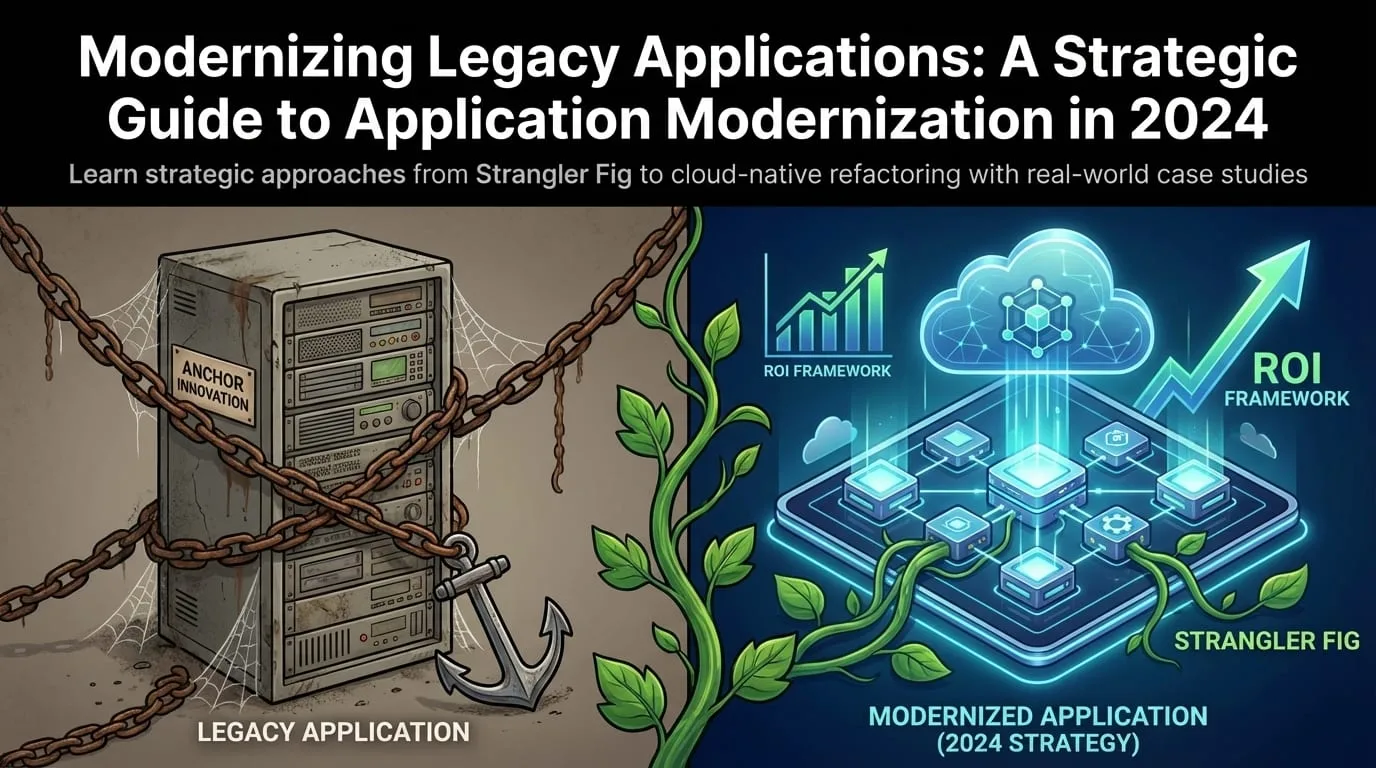
Legacy applications are the workhorses of the enterprise. They process billions in transactions, manage critical records, and keep the lights on. But they're often brittle, expensive to maintain, and impossible to scale. Modernization isn't just an IT upgrade-it's a business imperative that can unlock innovation, reduce costs, and accelerate time-to-market.
In this comprehensive guide, we'll explore proven modernization strategies, help you choose the right approach for your situation, and share frameworks for building a compelling business case.
The True Cost of Legacy Systems
Before exploring solutions, let's quantify the problem. Many organizations underestimate the hidden costs of maintaining legacy systems:
Direct Costs
| Cost Category | Typical Impact |
|---|---|
| Maintenance overhead | 60-80% of IT budget |
| Infrastructure (on-prem) | 3-5x cloud equivalent |
| Specialized talent | 2-3x market rates for legacy skills |
| Compliance/security patches | Growing exponentially |
Hidden Costs
Technical Debt Compound Interest Every patch makes the next change harder. What took 1 day five years ago now takes 2 weeks. This compounds:
- Feature velocity decreases 10-15% annually
- Bug fix time increases proportionally
- Testing becomes increasingly complex
Security Exposure Outdated frameworks often contain unpatched vulnerabilities:
- 78% of breaches involve known vulnerabilities (Verizon DBIR)
- Legacy systems are prime targets for attackers
- Compliance frameworks (SOC2, PCI-DSS) become harder to maintain
Talent Crisis Finding developers for legacy technologies is increasingly difficult:
- COBOL developers average age: 55+
- VB6, PowerBuilder experts retiring
- Junior developers won't join legacy teams
- Institutional knowledge walks out the door
Opportunity Cost Perhaps the biggest cost-what you can't do:
- Can't integrate modern APIs and services
- Can't scale for new business opportunities
- Can't provide modern user experiences
- Can't attract digital-native customers
Modernization Strategy Framework
There's no one-size-fits-all solution. The classic "6 Rs" framework helps categorize your options:
The 6 Rs of Cloud Migration
| Strategy | Description | Effort | Risk | ROI Timeline |
|---|---|---|---|---|
| Retain | Keep as-is (for now) | None | None | N/A |
| Retire | Decommission | Low | Low | Immediate |
| Rehost | Lift and shift | Low | Low | 6-12 months |
| Replatform | Lift and reshape | Medium | Medium | 12-18 months |
| Refactor | Re-architect | High | High | 18-36 months |
| Replace | Buy SaaS/COTS | Medium | Medium | 6-18 months |
Choosing the Right Strategy
Retain When:
- System works and isn't blocking business goals
- Modernization cost exceeds remaining system lifetime
- Regulatory requirements mandate specific architecture
Retire When:
- Functionality is no longer needed
- Duplicate systems exist
- Usage has declined significantly
Rehost (Lift & Shift) When:
- Quick cloud migration needed (data center exit)
- Application is stable but infrastructure is the problem
- Cloud benefits (disaster recovery, elasticity) are priority
Replatform When:
- Application needs modest optimization
- Want cloud benefits without full rewrite
- Can containerize existing code
Refactor When:
- Application is strategic and will exist long-term
- Current architecture blocks required capabilities
- Team has capacity for significant investment
Replace When:
- Commodity functionality (HR, CRM, ERP)
- Better SaaS solutions exist
- Maintaining custom code isn't a competitive advantage
Deep Dive: High-Impact Modernization Patterns
Pattern 1: The Strangler Fig (Recommended)
Named after the strangler fig tree that grows around its host, this pattern gradually replaces legacy functionality with modern services.
How It Works:
Phase 1: Identify and Isolate
┌─────────────────────────────────────┐
│           Legacy Monolith           │
│  ┌─────┐ ┌─────┐ ┌─────┐ ┌─────┐   │
│  │Auth │ │Order│ │Inv. │ │Report│   │
│  └─────┘ └─────┘ └─────┘ └─────┘   │
└─────────────────────────────────────┘

Phase 2: Build New Service
┌─────────────────────────────────────┐
│           Legacy Monolith           │
│  ┌─────┐ ┌─────┐ ┌─────┐ ┌─────┐   │
│  │Auth │ │Order│ │Inv. │ │Report│   │
│  └─────┘ └─────┘ └─────┘ └─────┘   │
└─────────────────────────────────────┘
              │
         [Facade/Router]
              │
┌─────────────────────────────────────┐
│    New Auth Service (Building)      │
└─────────────────────────────────────┘

Phase 3: Route Traffic
┌─────────────────────────────────────┐
│           Legacy Monolith           │
│  ┌─────┐ ┌─────┐ ┌─────┐ ┌─────┐   │
│  │░░░░░│ │Order│ │Inv. │ │Report│   │
│  └─────┘ └─────┘ └─────┘ └─────┘   │
└─────────────────────────────────────┘
              │
         [Facade/Router]───────────┐
              │                    │
              │         ┌──────────┴──────────┐
              │         │  New Auth Service   │
              │         │  (100% Traffic)     │
              │         └─────────────────────┘

Phase 4: Retire Legacy Component
┌─────────────────────────────────────┐
│           Legacy Monolith           │
│  ┌─────┐ ┌─────┐ ┌─────┐           │
│  │Order│ │Inv. │ │Report│           │
│  └─────┘ └─────┘ └─────┘           │
└─────────────────────────────────────┘
              │
         [Facade/Router]───────────┐
                                   │
                        ┌──────────┴──────────┐
                        │  New Auth Service   │
                        └─────────────────────┘

Repeat for each component...
Implementation Steps:
- Identify Seams: Find natural boundaries in the monolith
- Build Facade: Create an API gateway or routing layer
- Extract Service: Build new functionality separately
- Migrate Data: Synchronize or migrate relevant data
- Route Traffic: Gradually shift requests to new service
- Retire Code: Remove legacy code once stable
- Repeat: Continue for next functionality area
Advantages:
- Low risk-rollback is always possible
- Incremental value delivery
- Learning applied to subsequent extractions
- Business continuity maintained
Challenges:
- Requires routing infrastructure
- Data synchronization complexity
- Longer overall timeline
- Parallel maintenance burden
Pattern 2: Replatforming (Lift and Reshape)
Modernize the infrastructure without rewriting application logic.
Common Replatforming Moves:
| From | To | Benefit |
|---|---|---|
| On-prem VMs | Cloud VMs | Elasticity, DR, cost |
| Bare metal | Containers | Portability, density |
| Self-managed DB | Managed DB (RDS) | Operations reduction |
| Manual deployment | CI/CD pipelines | Velocity, reliability |
| Monolith | Modular monolith | Easier future extraction |
Containerization Strategy:
# Example: Containerizing a legacy Java app
FROM eclipse-temurin:11-jre-jammy

# Copy legacy JAR
COPY target/legacy-app.jar /app/app.jar

# Legacy apps often need specific configurations
ENV JAVA_OPTS="-Xmx512m -Xms256m"
ENV LEGACY_CONFIG_PATH="/config"

# Health check for orchestration
HEALTHCHECK --interval=30s --timeout=10s \
  CMD curl -f http://localhost:8080/health || exit 1

EXPOSE 8080
CMD ["java", "-jar", "/app/app.jar"]
Pattern 3: Cloud-Native Refactoring
Complete re-architecture to leverage cloud capabilities fully.
Modern Architecture Components:
┌─────────────────────────────────────────────────────────┐
│                      API Gateway                         │
│              (Rate Limiting, Auth, Routing)              │
└────────────────────────┬────────────────────────────────┘
                         │
    ┌────────────────────┼────────────────────┐
    │                    │                    │
┌───┴───┐           ┌────┴────┐          ┌───┴───┐
│Service│           │Service  │          │Service│
│   A   │           │    B    │          │   C   │
│(k8s)  │           │(Lambda) │          │(ECS)  │
└───┬───┘           └────┬────┘          └───┬───┘
    │                    │                    │
    │         ┌──────────┴──────────┐         │
    │         │    Event Bus        │         │
    │         │ (EventBridge/Kafka) │         │
    │         └─────────────────────┘         │
    │                                         │
┌───┴───────────────────┐   ┌─────────────────┴───┐
│   PostgreSQL (RDS)    │   │   DynamoDB/Mongo    │
│   (Transactional)     │   │   (High-scale read) │
└───────────────────────┘   └─────────────────────┘
Cloud-Native Principles:
- Stateless services: No local state; use external stores
- Containerized: Consistent deployment across environments
- Observable: Metrics, logs, traces built-in
- Resilient: Circuit breakers, retries, graceful degradation
- Automated: Infrastructure as code, GitOps deployment
Success Factors for Modernization
Based on hundreds of modernization projects, these factors separate success from failure:
1. Executive Sponsorship
Modernization requires sustained investment:
- Multi-quarter/multi-year commitment
- Protected funding (not discretionary)
- Clear ownership at C-level
- Regular progress visibility
2. Automated Testing Foundation
You cannot safely refactor without tests:
Testing Pyramid for Legacy Code:
                    ┌────────────┐
                    │   E2E      │  ← Critical paths
                    │   Tests    │
                   ┌┴────────────┴┐
                   │ Integration  │  ← API contracts
                   │    Tests     │
                  ┌┴──────────────┴┐
                  │   Unit Tests   │  ← New code only
                  └────────────────┘
Characterization Testing Strategy: When legacy code lacks documentation:
- Write tests that capture current behavior
- Don't judge if behavior is "correct"
- Use as safety net during refactoring
- Fix "bugs" only after understanding intent
3. DevOps Culture and Practices
Modern infrastructure requires modern operations:
| Practice | Why It Matters |
|---|---|
| CI/CD Pipelines | Frequent, reliable deployments |
| Infrastructure as Code | Reproducible environments |
| Feature Flags | Safe rollouts, instant rollback |
| Monitoring/Alerting | Catch issues before users |
4. Incremental Delivery
Big-bang migrations fail. Plan for incremental value:
90-Day Milestones:
- Day 30: First component in production (even if 1% traffic)
- Day 60: Metrics showing improvement
- Day 90: Business stakeholder can see impact
5. Knowledge Capture
Legacy knowledge often exists only in people's heads:
- Archaeological digs: Scheduled sessions to document behavior
- Pairing: New developers pair with legacy experts
- ADRs: Architecture Decision Records for new decisions
- Runbooks: Operational documentation for all components
Building the Business Case
Modernization competes for budget with feature development. Here's how to build a compelling case:
Quantify Current State Costs
Developer Productivity Analysis:
Current state:
- Average feature delivery: 6 weeks
- Bug fix time: 3 days
- Deployment frequency: Monthly
- Failed deployment rate: 25%

Estimated modernization impact:
- Feature delivery: 2 weeks (-67%)
- Bug fix time: 4 hours (-83%)
- Deployment frequency: Daily
- Failed deployment rate: 5%

Annual developer cost: $2M
Productivity improvement: 40%
Annual savings: $800K
Risk Quantification:
Probability of major outage: 30%/year
Average outage cost: $500K
Expected annual risk cost: $150K

Post-modernization probability: 5%/year
Expected annual risk cost: $25K
Risk reduction value: $125K/year
Total Cost of Ownership Model
5-Year TCO Analysis

                    Legacy (As-Is)    Modernized
                    ──────────────    ──────────
Year 1 Maintenance     $1.2M            $2.0M*
Year 2 Maintenance     $1.4M            $0.6M
Year 3 Maintenance     $1.6M            $0.5M
Year 4 Maintenance     $1.8M            $0.5M
Year 5 Maintenance     $2.0M            $0.5M
                    ──────────────    ──────────
5-Year Total           $8.0M            $4.1M

*Includes modernization investment

Net 5-Year Savings: $3.9M
Intangible Benefits
Don't forget to communicate:
- Talent acquisition/retention improvements
- Time-to-market acceleration
- Customer experience enhancement
- Competitive positioning
- Technical debt reduction
Common Modernization Anti-Patterns
Learn from others' mistakes:
1. The Big Bang Rewrite
Mistake: "Let's rebuild everything from scratch" Reality: Takes 2-3x longer than estimated, often fails Better: Strangler fig pattern with incremental replacement
2. Technology-First Thinking
Mistake: "We need Kubernetes/microservices/serverless" Reality: Technology choice should follow requirements Better: Start with business outcomes, work backward to technology
3. Underestimating Data Migration
Mistake: "The data migration will be straightforward" Reality: Data is messy, undocumented, and critical Better: Plan for 30-40% of effort on data migration
4. Ignoring Organizational Change
Mistake: "We just need to change the technology" Reality: New architecture requires new skills and processes Better: Include training, hiring, and process changes in plan
5. Scope Creep Disguised as Modernization
Mistake: "While we're at it, let's add these features" Reality: Mixing modernization and feature development adds risk Better: Separate modernization sprints from feature sprints
Key Takeaways
- Quantify current costs before building the business case
- Choose strategy based on context - not every app needs full refactoring
- Strangler fig is usually the safest approach for critical systems
- Invest in testing first - you can't refactor what you can't test
- Plan for incremental delivery - show value every 90 days
- Don't underestimate organizational change - technology is the easy part
- Capture knowledge aggressively - it walks out the door daily
Legacy systems don't have to be anchors. With the right strategy and execution discipline, modernization can unlock innovation, reduce costs, and position your organization for the future.
Planning a legacy modernization initiative? Contact EGI Consulting for an assessment and modernization roadmap tailored to your systems and goals.
Keep reading
All articles
Green Software Engineering: Building Sustainable, Carbon-Efficient Systems
Observability Strategy for Modern Applications: Logs, Metrics, Traces, and Business Signals
Taming the Kraken: A Complete Guide to Managing Technical Debt in Software Projects
Get new articles by email.
One or two a month. No marketing, no forwarding your address. Unsubscribe anytime.