Green Software Engineering: Building Sustainable, Carbon-Efficient Systems
The tech industry's carbon footprint rivals aviation. Learn how to measure, reduce, and optimize your software's environmental impact with Green Software Engineering principles.
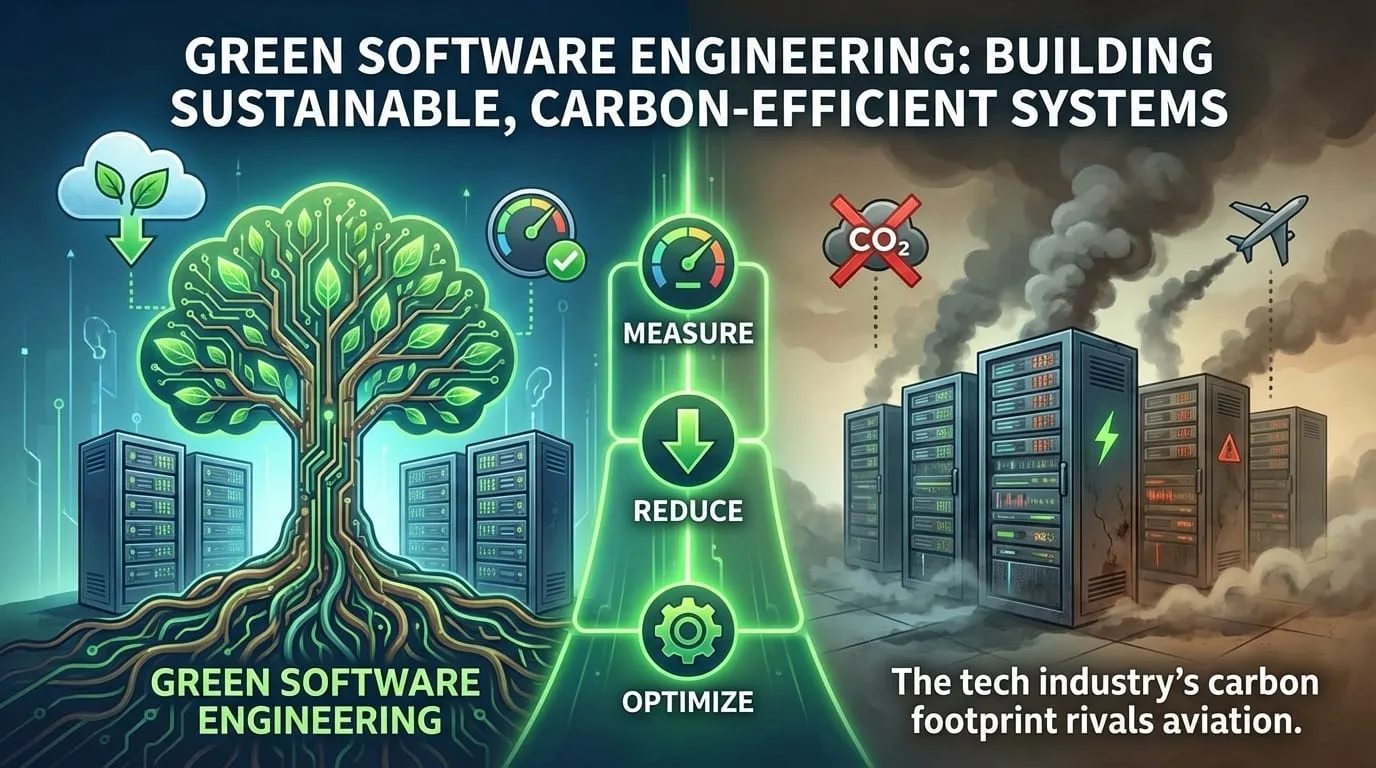
The internet accounts for roughly 4% of global greenhouse gas emissions-on par with the airline industry. Every line of code runs on hardware that consumes electricity. Every API call, every database query, every Docker container draws power from a grid that's often still powered by fossil fuels.
Green Software Engineering is the discipline of building software that emits fewer carbon emissions. It's not just about saving the planet-it's about building efficient, cost-effective systems that perform better.
The Carbon Footprint of Software
Where Software Carbon Emissions Come From
──────────────────────────────────────────────────────────────────

                    Software Carbon = Energy × Carbon Intensity
                              │
          ┌───────────────────┼───────────────────┐
          ▼                   ▼                   ▼
   ┌─────────────┐     ┌─────────────┐     ┌─────────────┐
   │  Hardware   │     │  Operations │     │  Network    │
   │  (Embodied) │     │  (Compute)  │     │  (Data Tx)  │
   │             │     │             │     │             │
   │ • Servers   │     │ • CPU       │     │ • CDN       │
   │ • Storage   │     │ • Memory    │     │ • API calls │
   │ • Networks  │     │ • GPU       │     │ • Downloads │
   │             │     │ • Storage   │     │             │
   │   ~20%      │     │   ~60%      │     │   ~20%      │
   └─────────────┘     └─────────────┘     └─────────────┘
The Numbers That Matter
| Component | Energy Impact | Scale |
|---|---|---|
| Single Google Search | 0.3 Wh | 5.4 million searches/minute |
| Training GPT-3 | 1,287 MWh | 552 tons CO₂ |
| Bitcoin Annual | 127 TWh | More than Norway |
| Global Data Centers | 200-250 TWh/year | 1% of global electricity |
| Video Streaming (1 hour) | 36g CO₂ | 1 billion hours watched daily |
Every optimization you make at scale has a measurable environmental impact.
The Three Pillars of Green Software
1. Carbon Efficiency: Do More with Less Energy
The most sustainable kilowatt is the one you don't use.
Carbon Efficiency Hierarchy
──────────────────────────────────────────────────────────────────

Most Impact ─────────────────────────────────────────► Least Impact

┌──────────────┐    ┌──────────────┐    ┌──────────────┐
│   Eliminate  │ →  │   Optimize   │ →  │   Offset     │
│              │    │              │    │              │
│ Don't build  │    │ Make it      │    │ Carbon       │
│ what's not   │    │ efficient    │    │ credits      │
│ needed       │    │              │    │ (last resort)│
└──────────────┘    └──────────────┘    └──────────────┘
Code-Level Efficiency
// ❌ Inefficient: O(n²) complexity, unnecessary iterations
function findDuplicates(items: string[]): string[] {
  const duplicates: string[] = [];
  for (let i = 0; i < items.length; i++) {
    for (let j = i + 1; j < items.length; j++) {
      if (items[i] === items[j] && !duplicates.includes(items[i])) {
        duplicates.push(items[i]);
      }
    }
  }
  return duplicates;
}

// ✅ Efficient: O(n) complexity, single pass
function findDuplicates(items: string[]): string[] {
  const seen = new Set<string>();
  const duplicates = new Set<string>();

  for (const item of items) {
    if (seen.has(item)) {
      duplicates.add(item);
    } else {
      seen.add(item);
    }
  }

  return Array.from(duplicates);
}

// At scale (1M items, 1000 requests/day):
// Inefficient: ~500 billion operations/day
// Efficient: ~1 billion operations/day
// Energy savings: 99.8%
Data Transfer Efficiency
// Image optimization - significant energy impact
const imageConfig = {
  // Use modern formats (30-50% smaller than JPEG)
  formats: ["avif", "webp", "jpeg"],

  // Responsive images - don't send 4K to mobile
  sizes: [
    { width: 640, suffix: "sm" },
    { width: 1024, suffix: "md" },
    { width: 1920, suffix: "lg" },
  ],

  // Aggressive compression
  quality: {
    avif: 65,
    webp: 75,
    jpeg: 80,
  },

  // Lazy loading - don't load what's not visible
  loading: "lazy",
};

// API response optimization
interface GreenApiResponse<T> {
  data: T;
  _meta: {
    compressed: boolean;
    cachedUntil: string;
    carbonSaved: number; // grams CO₂
  };
}

// Pagination reduces data transfer
async function getUsers(page: number, limit: number = 20) {
  // Don't return 10,000 users when showing 20
  return db.users.findMany({
    skip: page * limit,
    take: limit,
    select: {
      id: true,
      name: true,
      email: true,
      // Don't include avatar blob in list view
    },
  });
}
2. Carbon Awareness: Run When/Where the Grid Is Clean
The carbon intensity of electricity varies by time and location:
Carbon Intensity by Time of Day (Typical Grid)
──────────────────────────────────────────────────────────────────

Carbon Intensity (gCO₂/kWh)
    │
500 │        ┌───┐
    │        │   │       ┌───┐
400 │    ┌───┤   │       │   │
    │    │   │   │   ┌───┤   │
300 │    │   │   │   │   │   │
    │────┤   │   │───┤   │   │───
200 │    │   │   │   │   │   │
    │    │   │   │   │   │   │
100 │────┴───┴───┴───┴───┴───┴───
    │
  0 └──────────────────────────────────
    00:00    06:00    12:00    18:00    24:00

    │ Low (overnight, solar)
    │ Medium (morning ramp, evening)
    │ High (peak demand, 4-8 PM)
Demand Shifting
from datetime import datetime
from carbon_api import get_grid_intensity, get_forecast

class CarbonAwareScheduler:
    """Schedule workloads when carbon intensity is lowest."""

    def __init__(self, max_intensity: int = 200):
        self.max_intensity = max_intensity  # gCO2/kWh

    async def schedule_batch_job(
        self,
        job: BatchJob,
        deadline: datetime,
        required_hours: int
    ) -> ScheduleResult:
        # Get carbon intensity forecast
        forecast = await get_forecast(
            start=datetime.now(),
            end=deadline,
            region=job.region
        )

        # Find the lowest-carbon window
        windows = self.find_low_carbon_windows(
            forecast,
            required_hours,
            self.max_intensity
        )

        if not windows:
            # Fallback: run anyway but log carbon cost
            return ScheduleResult(
                scheduled_time=datetime.now(),
                carbon_intensity=await get_grid_intensity(job.region),
                optimal=False
            )

        best_window = min(windows, key=lambda w: w.avg_intensity)
        return ScheduleResult(
            scheduled_time=best_window.start,
            carbon_intensity=best_window.avg_intensity,
            optimal=True,
            carbon_saved=self.calculate_savings(
                windows[-1].avg_intensity,
                best_window.avg_intensity,
                required_hours
            )
        )
Geographic Shifting
# Multi-region deployment with carbon awareness
regions:
  # Lower carbon - prioritize these
  - name: europe-north1 # Finland, ~20 gCO2/kWh (hydro/nuclear)
    carbon_intensity: 20
    priority: 1

  - name: us-west1 # Oregon, ~30 gCO2/kWh (hydro)
    carbon_intensity: 30
    priority: 2

  - name: northamerica-northeast1 # Montreal, ~25 gCO2/kWh (hydro)
    carbon_intensity: 25
    priority: 2

  # Higher carbon - use for latency requirements only
  - name: us-east4 # Virginia, ~350 gCO2/kWh (coal/gas mix)
    carbon_intensity: 350
    priority: 4

  - name: asia-east1 # Taiwan, ~500 gCO2/kWh (coal heavy)
    carbon_intensity: 500
    priority: 5
3. Hardware Efficiency: Maximize Utilization
Hardware Carbon - Embodied vs. Operational
──────────────────────────────────────────────────────────────────

Typical Server Lifecycle (5 years):

Embodied Carbon (Manufacturing)
├── Mining raw materials
├── Manufacturing components
├── Assembly and shipping
└── Total: ~1,000 kg CO₂

Operational Carbon (Running)
├── Power consumption
├── Cooling
├── Network equipment
└── Total: ~3,000 kg CO₂ (over 5 years)

Key Insight:
├── Extending server life from 3 to 5 years = 40% less embodied carbon
├── Running at 80% utilization vs 20% = 4x efficiency
└── Cloud multi-tenancy = shared embodied carbon
Rightsizing Infrastructure
// Measure before optimizing
interface ResourceMetrics {
  cpuUtilization: number; // Target: 60-80%
  memoryUtilization: number; // Target: 70-85%
  costPerRequest: number; // $/1000 requests
  carbonPerRequest: number; // gCO₂/1000 requests
}

async function analyzeAndRightsize(
  service: string,
  period: Duration = "7d"
): Promise<RightsizeRecommendation> {
  const metrics = await getMetrics(service, period);

  if (metrics.cpuUtilization < 20) {
    return {
      action: "DOWNSIZE",
      currentSize: metrics.instanceType,
      recommendedSize: getSmallerInstance(metrics.instanceType),
      estimatedSavings: {
        costReduction: 50,
        carbonReduction: 50,
      },
    };
  }

  if (metrics.cpuUtilization > 85) {
    return {
      action: "UPSIZE_OR_SCALE",
      reason: "High utilization may cause performance issues",
    };
  }

  return { action: "NO_CHANGE" };
}
Measuring Software Carbon
Software Carbon Intensity (SCI)
The Green Software Foundation's SCI spec:
SCI = ((E × I) + M) / R

Where:
├── E = Energy consumed (kWh)
├── I = Carbon intensity of grid (gCO₂/kWh)
├── M = Embodied carbon (gCO₂)
└── R = Functional unit (per user, per request, per transaction)
Implementing SCI Measurement
interface SciCalculation {
  energy: {
    compute: number; // kWh
    network: number; // kWh
    storage: number; // kWh
  };
  carbonIntensity: number; // gCO₂/kWh
  embodiedCarbon: number; // gCO₂ (amortized)
  functionalUnit: number; // requests, users, etc.
}

function calculateSci(data: SciCalculation): SciResult {
  const totalEnergy = Object.values(data.energy).reduce((a, b) => a + b, 0);
  const operationalCarbon = totalEnergy * data.carbonIntensity;
  const totalCarbon = operationalCarbon + data.embodiedCarbon;
  const sci = totalCarbon / data.functionalUnit;

  return {
    sci,
    unit: "gCO₂/request",
    breakdown: {
      operational: operationalCarbon / data.functionalUnit,
      embodied: data.embodiedCarbon / data.functionalUnit,
    },
  };
}

// Example: Calculate SCI for an API
const apiSci = calculateSci({
  energy: {
    compute: 100, // 100 kWh/day
    network: 20, // 20 kWh/day
    storage: 10, // 10 kWh/day
  },
  carbonIntensity: 400, // 400 gCO₂/kWh (US average)
  embodiedCarbon: 50, // 50 gCO₂/day (amortized server)
  functionalUnit: 1_000_000, // 1M requests/day
});

// Result: 0.052 gCO₂/request
Green Architecture Patterns
Pattern 1: Serverless for Variable Workloads
Serverless vs. Always-On Comparison
──────────────────────────────────────────────────────────────────

Workload: 1000 requests/hour (variable, with 10 hours of low traffic)

Always-On (EC2/VM):
├── 24 hours × 0.5 kWh = 12 kWh/day
└── Running even when idle

Serverless (Lambda):
├── 1000 req × 200ms × 24 hours = 4.8M ms = 1.33 hours compute
├── 1.33 hours × 0.1 kWh = 0.13 kWh/day
└── Zero when idle

Energy Savings: 98.9%
Pattern 2: Caching and Edge Computing
// Multi-tier caching reduces origin requests
const cachingStrategy = {
  browser: {
    ttl: "1 hour",
    assets: ["images", "fonts", "static-js"],
    impact: "60% fewer requests",
  },
  cdn: {
    ttl: "24 hours",
    content: ["api responses", "rendered pages"],
    impact: "80% fewer origin hits",
  },
  application: {
    ttl: "5 minutes",
    content: ["database queries", "computed results"],
    impact: "90% fewer database calls",
  },
};

// Edge functions reduce data travel distance
// 100ms latency = ~1000km of fiber
// Serving from edge = less network energy
const edgeConfig = {
  functions: [
    {
      name: "personalization",
      locations: ["global"],
      impact: "Reduces round-trip by ~2000km average",
    },
    {
      name: "image-optimization",
      locations: ["regional"],
      impact: "Processes images closer to user",
    },
  ],
};
Pattern 3: Efficient Data Storage
-- Data lifecycle management
-- Old data costs carbon to store AND to query

-- Tiered storage approach
CREATE TABLE events (
  id UUID PRIMARY KEY,
  created_at TIMESTAMP,
  data JSONB
) PARTITION BY RANGE (created_at);

-- Hot data: Last 30 days (fast SSD)
CREATE TABLE events_hot PARTITION OF events
  FOR VALUES FROM ('2024-06-01') TO (MAXVALUE);

-- Cold data: Older than 30 days (archive storage)
-- Move to S3 Glacier = 80% storage cost/energy reduction

-- Automatic cleanup
DELETE FROM events_hot WHERE created_at < NOW() - INTERVAL '30 days';

-- Compression (50-90% storage reduction)
ALTER TABLE events_hot SET (
  toast_tuple_target = 128,
  compression = 'zstd'
);
Building a Sustainability Practice
Green Software Development Lifecycle
Green SDLC Integration Points
──────────────────────────────────────────────────────────────────

Design Phase
├── Choose efficient algorithms (O(n) vs O(n²))
├── Plan for caching and CDN
├── Select carbon-aware cloud regions
└── Design for minimal data transfer

Development Phase
├── Profile code for efficiency
├── Optimize bundle sizes
├── Use lazy loading
└── Implement efficient queries

CI/CD Pipeline
├── Measure carbon impact per deployment
├── Gate deployments on SCI thresholds
├── Optimize build processes
└── Cache dependencies aggressively

Production
├── Monitor energy consumption
├── Enable carbon-aware scaling
├── Right-size infrastructure
└── Schedule batch jobs for low-carbon windows

Review
├── Track SCI over time
├── Report sustainability metrics
├── Identify optimization opportunities
└── Set reduction targets
Sustainability Metrics Dashboard
| Metric | Current | Target | Status |
|---|---|---|---|
| SCI (gCO₂/request) | 0.05 | 0.03 | 🔴 |
| Server Utilization | 45% | 70% | 🟡 |
| Cache Hit Rate | 78% | 90% | 🟡 |
| Bundle Size | 450KB | 200KB | 🔴 |
| Renewable Energy % | 60% | 100% | 🟡 |
| Idle Resource Cost | $5,000/mo | $1,000/mo | 🔴 |
The Business Case for Green Software
Green Software ROI
──────────────────────────────────────────────────────────────────

Direct Benefits:
├── Lower cloud costs (efficiency = cost savings)
├── Better performance (efficient code is fast code)
├── Reduced infrastructure (less over-provisioning)
└── Avoided carbon taxes (coming to more jurisdictions)

Indirect Benefits:
├── ESG reporting compliance
├── B2B sales advantage (RFPs increasingly require sustainability)
├── Talent attraction (engineers care about impact)
└── Brand reputation

Example ROI:
├── 30% reduction in compute usage
├── Annual cloud spend: $1M
├── Savings: $300,000/year
├── Carbon reduction: 200 tons CO₂/year
└── Implementation cost: $50,000
└── ROI: 6x in year one
Key Takeaways
- Software has a carbon footprint-the tech industry rivals aviation in emissions
- Carbon efficiency = doing more with less energy (optimize algorithms, reduce data)
- Carbon awareness = running when/where the grid is cleanest
- Hardware efficiency = maximizing utilization, extending device life
- Measure with SCI-you can't improve what you don't measure
- Green = Efficient = Fast = Cheap-sustainability aligns with performance and cost goals
- Serverless and caching are powerful green patterns
- Build sustainability into the SDLC, not as an afterthought
Sustainability is the next frontier of software quality, alongside performance and security. The good news: energy-efficient code is usually faster and cheaper to run. It's a win-win-win.
Want to reduce your software's carbon footprint while cutting costs? Contact EGI Consulting for a sustainability assessment and actionable roadmap to green software engineering.
Keep reading
All articles
Cloud FinOps: A Complete Guide to Taming Cloud Costs and Maximizing ROI
Modernizing Legacy Applications: A Strategic Guide to Application Modernization in 2024

Taming the Kraken: A Complete Guide to Managing Technical Debt in Software Projects
Get new articles by email.
One or two a month. No marketing, no forwarding your address. Unsubscribe anytime.