MVP vs Prototype vs Proof of Concept: How to Choose the Right Validation Approach
Building the wrong thing perfectly is the most expensive mistake in product development. Learn the critical differences between MVPs, prototypes, and POCs, and get a practical framework for choosing the right approach every time.
Building the wrong thing perfectly is the most expensive mistake in product development. Yet every week, engineering teams debate whether to run a POC or ship an MVP, product managers request prototypes when they mean MVPs, and startups burn months building features no one asked for.
The confusion is understandable. These three terms appear constantly in product conversations, often used interchangeably. But they answer fundamentally different questions, serve different audiences, and require different levels of investment.
This guide will make the distinctions permanently clear and give you a decision framework you can apply to your next initiative.
Why the Terminology Confusion Costs Real Money
A fintech startup spent four months building a fully functional mobile app. It had authentication, transaction history, notifications, and a polished onboarding flow. Users could not figure out the core value proposition in testing. The team had shipped an MVP before validating whether the concept resonated. A two-week prototype would have revealed the UX problem for less than 5% of the total investment.
Conversely, a healthcare company wanted to use machine learning to detect anomalies in lab results. The team jumped straight to a prototype. Three months later, they discovered the model could not achieve the accuracy threshold required for clinical use. A one-week proof of concept would have surfaced this technical blocker on day five.
Getting the validation type right is not about vocabulary. It is about matching your investment to the specific question you need answered.
The Three Validation Missions
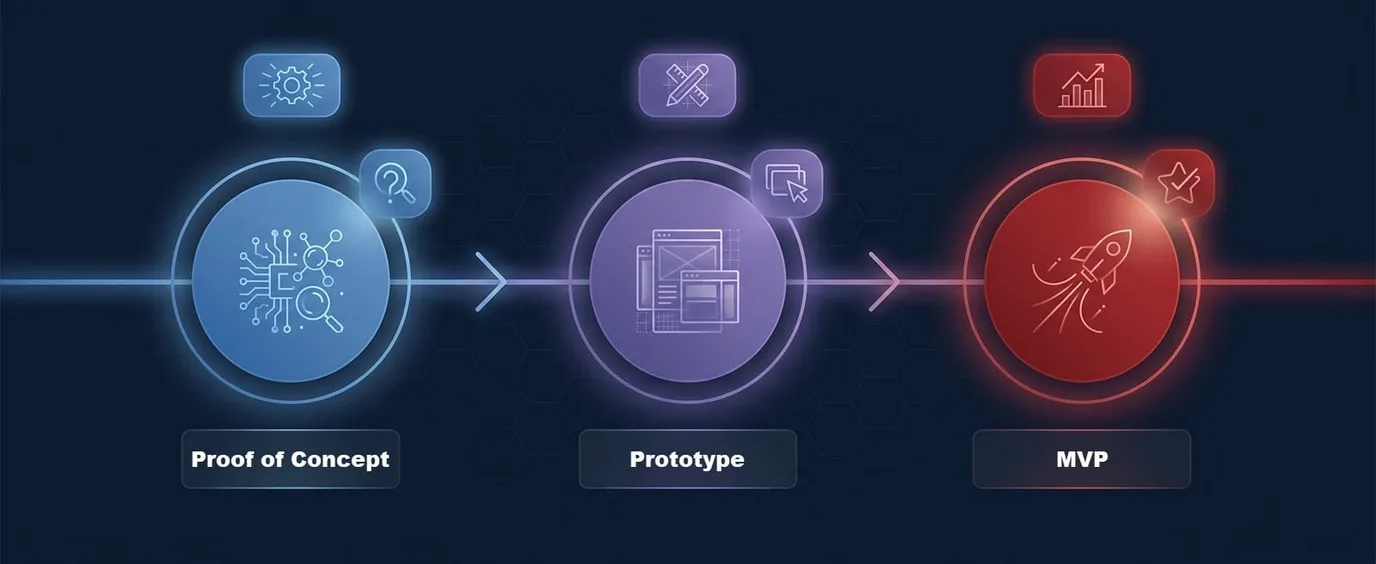
Each approach exists to answer a single, specific question.
| Approach | Core Question | Primary Audience | Typical Duration |
|---|---|---|---|
| Proof of Concept | Can we technically build this? | Internal: engineers, architects, leadership | 1 to 3 weeks |
| Prototype | Should it work this way? | External: target users, design stakeholders | 1 to 4 weeks |
| MVP | Will the market want this? | Real users in production | 4 to 16 weeks |
The key word in that table is "primary." All three generate learning, but each one is optimized for a different type of risk.
Proof of Concept: Eliminating Technical Risk
A POC validates that a technical approach is feasible. Nothing more.
When to Build a POC
- You want to integrate a technology your team has never used in production (LLMs, computer vision, a specific third-party API)
- The business idea depends on a technical capability that is unproven in your context
- Engineering estimates vary widely because no one has done the specific thing you are proposing
- Regulatory or security constraints make it unclear whether the approach is viable at all
What a POC Is (and Is Not)
A POC is a throwaway experiment. It should be:
- Narrow: Focused on one specific technical question
- Time-boxed: No more than two or three weeks before you get a verdict
- Honest about its limits: POC code is not production code
A POC is not a pilot, not a prototype, and not a starting point for your production codebase. One of the most costly mistakes is letting POC code become the foundation of a real product.
POC Outputs
At the end of a POC, you should have:
- A clear technical verdict: feasible, feasible with caveats, or not feasible
- A rough cost and complexity estimate if the approach is viable
- Any architectural constraints or dependencies identified
- A recommendation to proceed, pivot, or stop
Real-World POC Example
A logistics company wanted to use computer vision to identify damaged parcels from conveyor belt cameras. Before committing to a six-month development project, they ran a two-week POC: they acquired 500 sample images, trained a basic model, and measured accuracy against their minimum threshold of 94%.
The POC achieved 71% accuracy. Rather than discovering this after six months of build work, they spent two weeks learning they needed higher-quality cameras or a different approach altogether. The POC saved approximately eight months of engineering time.
Prototype: Eliminating Design and UX Risk
A prototype validates how something should work, look, and feel. It is not about whether something can be built. It is about whether users will understand and want to use it.
When to Build a Prototype
- You have a new user flow or feature but are uncertain how users will navigate it
- You need to validate design assumptions before committing engineering resources
- Multiple design directions are being debated and you need real user feedback to decide
- Accessibility or usability is a core concern that must be validated early
Prototype Fidelity Spectrum
Prototypes exist on a spectrum from paper sketches to near-functional interactive builds:
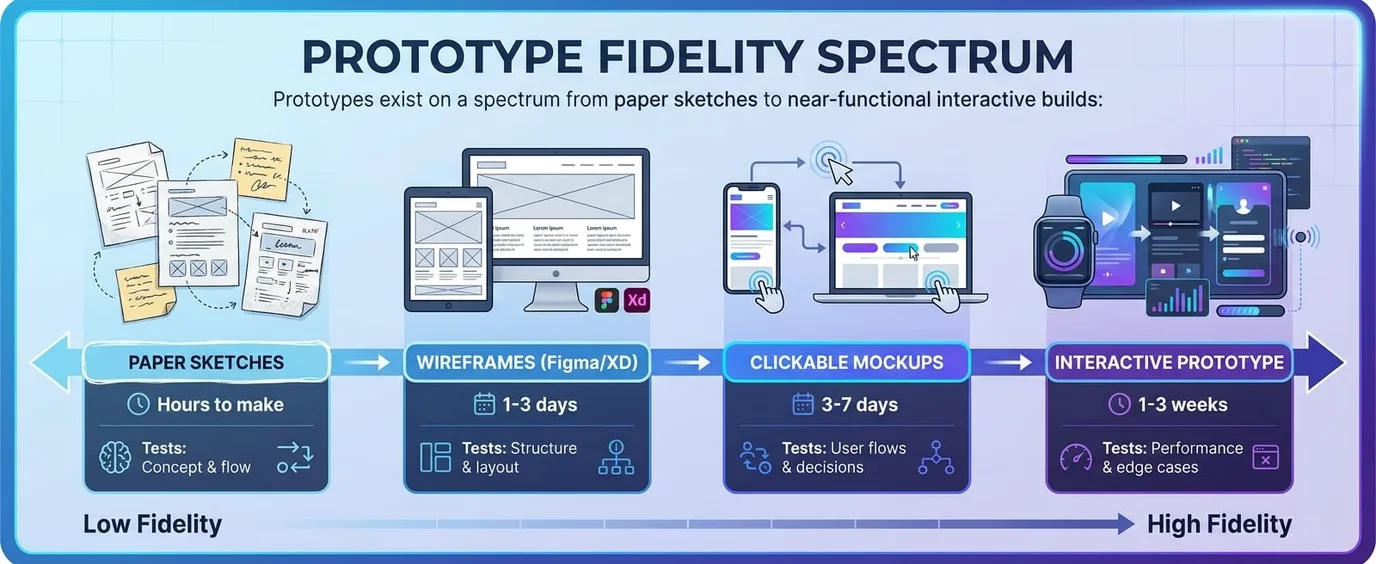
Start at the lowest fidelity that will still generate useful feedback. Do not spend three weeks on a pixel-perfect interactive prototype when a paper sketch would answer your core question in a single day.
What Prototype Testing Looks Like
Run five to eight user interviews with your target persona. Give each participant a specific task to complete. Observe without guiding. Listen for confusion, hesitation, and improvised workarounds.
The goal is qualitative insight, not statistical significance. Five users will surface roughly 80% of major usability issues.
Prototype Outputs
- Validated or invalidated design hypotheses
- Specific UI and copy changes to make before engineering handoff
- A prioritized list of UX issues by severity
- A tested design ready for implementation
MVP: Eliminating Market Risk
A Minimum Viable Product validates that real users, in a real market, will adopt and retain a product. It is the smallest thing you can build that delivers genuine value and generates meaningful market signal.
The "Viable" Problem
The most misused word in "MVP" is "viable." Teams routinely interpret it as "barely functional" or "missing features," which leads to products that fail not because the market rejected them, but because the product was too broken to give users a fair chance.
Viable means:
- It solves a real problem for a defined user
- The core experience works end to end without critical failures
- It is good enough that a user would choose to return
Viable does not mean polished, feature-complete, or scalable. An MVP for a marketplace might handle 100 transactions manually before any automation is built. But those 100 transactions must deliver real value to real buyers and sellers.
What Belongs in an MVP
Use this filter for every proposed feature:
For each feature, ask:
"If I removed this, could the user still complete the core job?"

Yes → The feature is not in MVP scope
No  → The feature belongs in MVP scope
This is harder than it sounds. Teams consistently rationalize features into scope. Apply the filter ruthlessly.
MVP Outputs
An MVP is not complete when it ships. It is complete when it has generated enough signal to make a build, pivot, or kill decision. That means measuring:
- Activation: Did users complete the core value action?
- Retention: Did users come back?
- Engagement: How frequently and deeply did users interact?
- Revenue or willingness to pay (if applicable)
The Decision Framework
Use the following sequence when starting any new initiative:
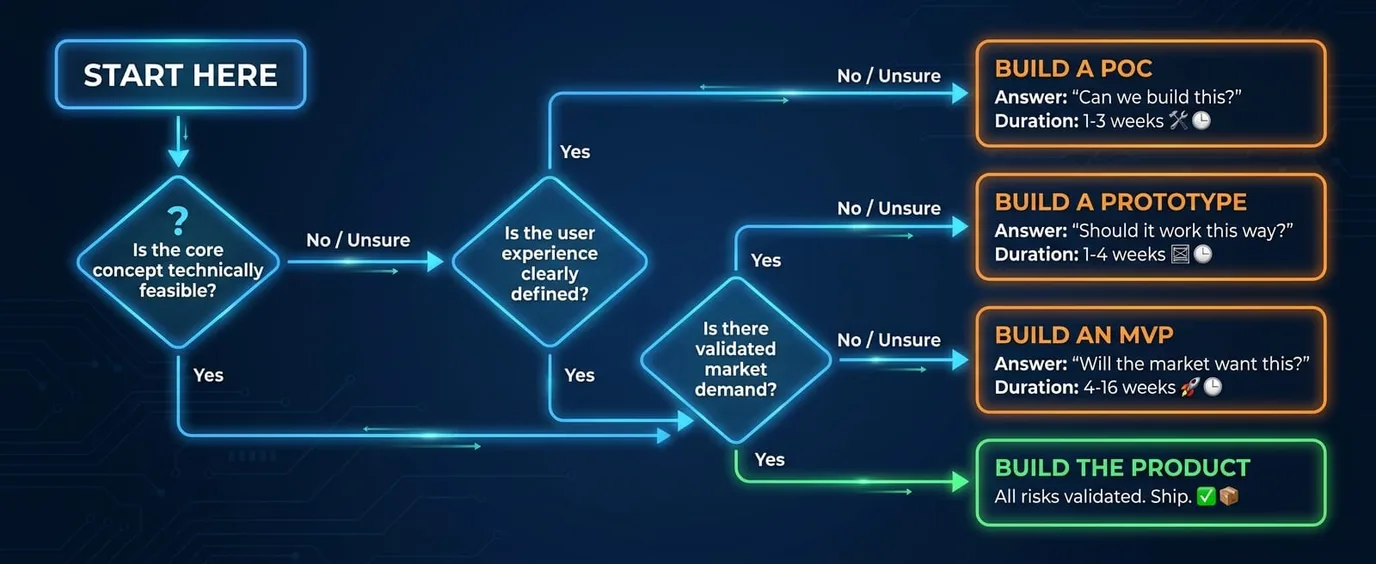
Work through these questions in order. If you hit an unresolved question, stop and build the appropriate validation artifact before proceeding.
Common Anti-Patterns
1. Skipping the POC and Discovering Technical Limits at Month Four
The most painful and common anti-pattern. A team builds through prototyping and into the MVP before discovering a fundamental technical constraint. Always identify technical unknowns before design work begins.
2. Polishing the POC into a Product
POC code is exploration code. It was written to answer a question, not to run in production. Treating it as a foundation leads to brittle architecture, security gaps, and maintenance debt. Once a POC answers its question, archive it and start the real build from scratch.
3. The "Full-Featured MVP"
An MVP with 47 features is not an MVP. It is a product with a misleading name. If every feature feels essential, apply the scope filter more aggressively or accept that you are building a product, not validating a concept.
4. Using a Prototype as Market Validation
A prototype tests how something works, not whether the market will pay for or adopt it. Positive feedback in a testing session ("this looks great!") is not the same as market validation. Real adoption behavior is what counts.
5. Measuring the Wrong Things
A POC should be measured by technical feasibility, not user engagement. An MVP should be measured by retention and activation, not feature usage counts. Use the metrics that match the question you are trying to answer.
Scenario Mapping
| Scenario | Right Approach | Why |
|---|---|---|
| "We want to add LLM-powered search to our app" | POC | Accuracy and latency are unknown until tested |
| "We need to redesign our checkout flow" | Prototype | Technical feasibility is known; UX is the risk |
| "We think there is a market for B2B invoice automation" | MVP | Concept is technically sound; market demand is the unknown |
| "We want to integrate with a new payment processor" | POC | API compatibility and edge cases are untested |
| "We are building a new user onboarding experience" | Prototype | Flow clarity and copy are the primary risks |
| "We are launching a new SaaS product category" | Prototype then MVP | Validate UX first, then validate market demand |
Practical Checklist
Before committing to any validation approach, run through the relevant checklist.
Choose a POC if any of the following apply:
- You are adopting a technology your team has not used in production
- Engineering estimates have a 3x or wider variance
- The concept depends on accuracy, performance, or latency thresholds you have not yet tested
- Regulatory or integration constraints remain unresolved
Choose a Prototype if all POC questions are resolved and any of these apply:
- You have multiple design directions without a clear winner
- Users are unfamiliar with the interaction patterns you are proposing
- You need stakeholder alignment before committing engineering resources
- A previous design failed in user testing and needs a new direction
Choose an MVP if both technical feasibility and UX are validated:
- You can identify the smallest version that delivers genuine value
- You have a defined cohort of target users ready to test in production
- You have clear metrics for activation, retention, and engagement
- The team agrees on the scope filter: if it is not core to the job, it is out
Key Takeaways
- Match validation to risk: POC eliminates technical risk, prototype eliminates design risk, MVP eliminates market risk
- Work in order: Resolve technical unknowns before design work; resolve design questions before market validation
- Throw away POC code: It answered a question and was never meant to scale
- Viable means useful, not polished: An MVP must deliver real value to real users in production
- Measure the right thing: Each validation type has its own success metric; mixing them leads to false conclusions
- Stop when you have your answer: The goal is learning, not building. Once you have the signal you need, make the call.
The discipline to match your investment to your uncertainty is what separates teams that learn quickly from teams that spend months building the wrong thing right.
Unsure which validation approach fits your next initiative? Contact EGI Consulting for a technical strategy session and we will help you design a validation plan that minimizes risk and accelerates time to market.
Keep reading
All articles
Why 70% of Digital Transformations Fail: Root Causes and How to Succeed
From Project to Product: A Complete Guide to Transforming Digital Delivery for the Modern Enterprise
AI Workflow Automation: How to Identify High-ROI Use Cases Before You Build
Get new articles by email.
One or two a month. No marketing, no forwarding your address. Unsubscribe anytime.