Scalable Cloud Architecture for High-Growth Startups: A Complete Guide to Building for Scale
Learn how to design cloud architecture that scales with your startup's growth. From MVP to millions of users-practical strategies for AWS, Azure, and GCP that won't break the bank.
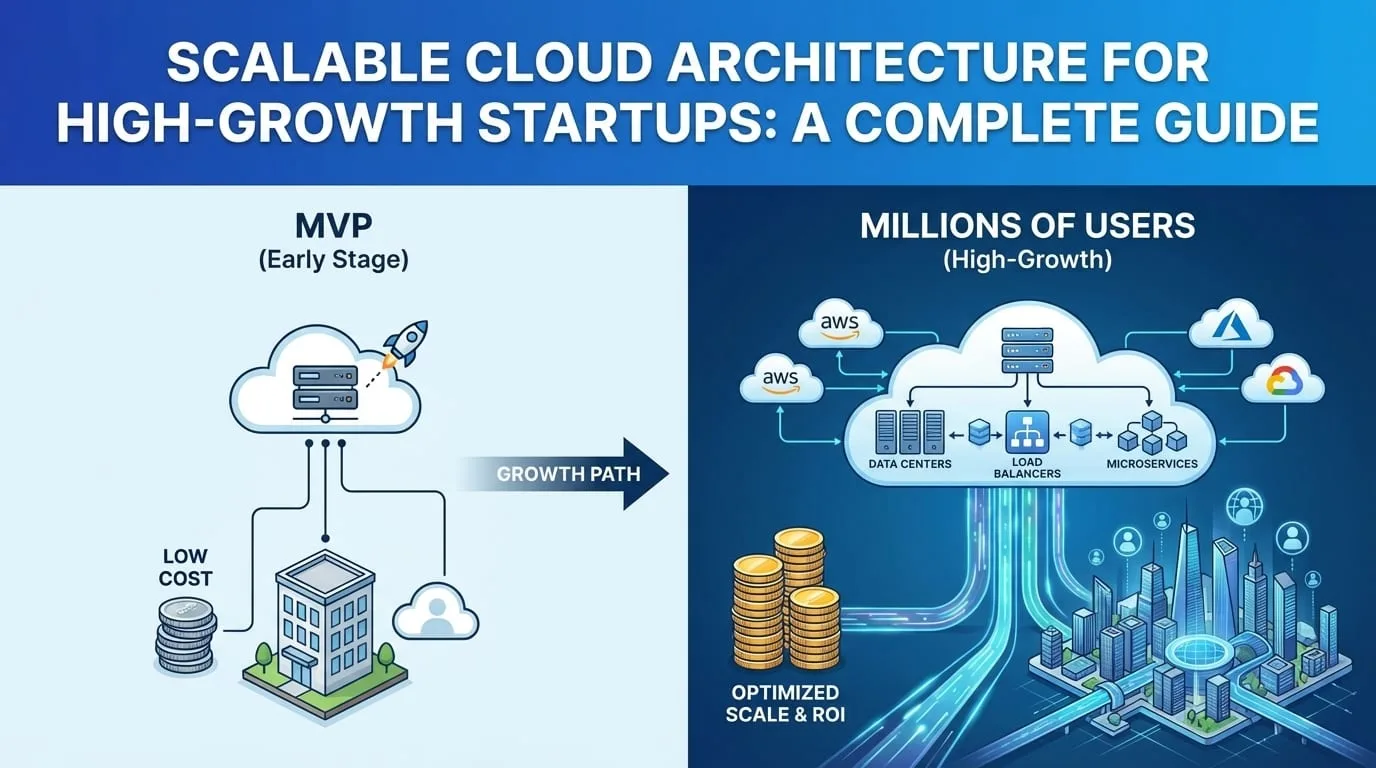
Every startup dreams of "hockey stick" growth. But if your infrastructure collapses when that growth hits, the dream becomes a nightmare. The key isn't to over-engineer from Day 1-it's to make architectural decisions that allow for friction-free scaling when you need it.
In this guide, we'll walk through a practical, phase-based approach to cloud architecture that grows with your business, avoiding both premature optimization and costly rewrites.
The Startup Cloud Architecture Lifecycle
Understanding where you are in your journey helps determine the right architectural investments:
| Phase | Users | Team Size | Priority | Architecture Focus |
|---|---|---|---|---|
| MVP | 0-1K | 1-5 | Speed to market | Simplicity, managed services |
| Growth | 1K-100K | 5-15 | Feature velocity | Decoupling bottlenecks |
| Scale | 100K-1M+ | 15-50+ | Reliability | Distributed systems, observability |
Phase 1: The MVP - Keep It Simple, Ship It Fast
In the beginning, speed is everything. A monolithic architecture is often the right choice.
Core Principles for MVP Architecture
Start with Platform-as-a-Service (PaaS) Don't manage infrastructure you don't need to:
- Vercel/Netlify: Perfect for frontend applications and serverless functions
- Railway/Render: Full-stack applications with managed databases
- AWS App Runner/Google Cloud Run: Container-based deployments without Kubernetes complexity
- Heroku: Still relevant for rapid prototyping
Use Managed Everything
- Database: Start with managed PostgreSQL (Supabase, Neon, RDS) or MongoDB Atlas
- Auth: Auth0, Clerk, or Firebase Authentication
- File Storage: S3/CloudFlare R2 with presigned URLs
- Email: SendGrid, Postmark, or AWS SES
Single Repository, Single Deployment
- One codebase, one CI/CD pipeline
- Easier debugging and development
- Lower cognitive overhead
MVP Architecture Example
┌─────────────────────────────────────────────────┐
│                   CDN (CloudFlare)               │
└─────────────────────────────────────────────────┘
                        │
┌─────────────────────────────────────────────────┐
│              Vercel / Railway / Render           │
│  ┌─────────────┐  ┌─────────────────────────┐   │
│  │   Next.js   │  │    API Routes/Backend    │   │
│  │  Frontend   │  │      (Same Deploy)       │   │
│  └─────────────┘  └─────────────────────────┘   │
└─────────────────────────────────────────────────┘
                        │
        ┌───────────────┼───────────────┐
        │               │               │
   ┌────┴────┐    ┌────┴────┐    ┌────┴────┐
   │ Managed │    │  Auth0  │    │   S3    │
   │Postgres │    │   Auth  │    │ Storage │
   └─────────┘    └─────────┘    └─────────┘
What NOT to Do at MVP Stage
- Don't deploy Kubernetes unless your team has K8s experience
- Don't build microservices - you don't have the team to support them
- Don't optimize prematurely - measure first, optimize later
- Don't build custom auth - use proven solutions
Phase 2: The Growth Phase - Strategic Decoupling
As traffic grows, bottlenecks emerge. Usually, the database is the first to choke. Here's how to address scaling challenges systematically.
Identify Bottlenecks First
Before adding complexity, understand where your system is struggling:
Key Metrics to Monitor
- Database query times (P50, P95, P99)
- API response times by endpoint
- CPU/Memory utilization patterns
- Queue depths (if applicable)
- Error rates by service/endpoint
Common First Bottlenecks
- Database read performance
- Expensive computations blocking requests
- Third-party API rate limits
- Image/file processing
Caching Strategy: Your First Line of Defense
Before sharding databases or adding services, implement caching:
Multi-Layer Caching Approach
┌────────────────────────────────────────────────────┐
│ Layer 1: Browser Cache (Cache-Control headers)     │
│ - Static assets: 1 year (with hash busting)        │
│ - API responses: Varies by endpoint                │
└────────────────────────────────────────────────────┘
                          │
┌────────────────────────────────────────────────────┐
│ Layer 2: CDN Cache (CloudFlare, CloudFront)        │
│ - Static files, images, fonts                      │
│ - Some API responses (with careful invalidation)   │
└────────────────────────────────────────────────────┘
                          │
┌────────────────────────────────────────────────────┐
│ Layer 3: Application Cache (Redis/Memcached)       │
│ - Session data                                     │
│ - Computed results                                 │
│ - Database query results                           │
└────────────────────────────────────────────────────┘
                          │
┌────────────────────────────────────────────────────┐
│ Layer 4: Database Query Cache                      │
│ - Prepared statements                              │
│ - Query plan caching                               │
└────────────────────────────────────────────────────┘
Redis Use Cases
// Session storage
await redis.set(`session:${userId}`, sessionData, 'EX', 3600);

// Expensive computation cache
const cacheKey = `report:${orgId}:${month}`;
let report = await redis.get(cacheKey);
if (!report) {
  report = await generateExpensiveReport(orgId, month);
  await redis.set(cacheKey, report, 'EX', 86400);
}

// Rate limiting
const requests = await redis.incr(`ratelimit:${ip}`);
if (requests === 1) {
  await redis.expire(`ratelimit:${ip}`, 60);
}
Async Processing: Don't Make Users Wait
Heavy operations should happen in the background:
What to Move to Background Jobs
- Email sending
- PDF/report generation
- Image processing and resizing
- Data imports/exports
- Analytics processing
- Webhook deliveries
Message Queue Options
| Solution | Best For | Complexity |
|---|---|---|
| Redis + BullMQ | Simple job queues, delays | Low |
| AWS SQS | Reliable, serverless | Low-Medium |
| RabbitMQ | Complex routing, priorities | Medium |
| Apache Kafka | Event streaming, high volume | High |
Example: Job Queue Pattern
// Producer (API endpoint)
app.post("/reports", async (req, res) => {
  const job = await reportQueue.add("generate", {
    userId: req.user.id,
    reportType: req.body.type,
    dateRange: req.body.dateRange,
  });

  res.json({
    jobId: job.id,
    status: "processing",
    statusUrl: `/reports/status/${job.id}`,
  });
});

// Consumer (Background worker)
reportQueue.process("generate", async (job) => {
  const report = await generateReport(job.data);
  await saveReport(job.data.userId, report);
  await notifyUser(job.data.userId, "Report ready!");
});
Database Scaling Strategies
1. Read Replicas (First Step)
- Direct all read queries to replica instances
- Keep primary for writes only
- Most managed databases support this out-of-the-box
// Example with Prisma
const prisma = new PrismaClient({
  datasources: {
    db: {
      url: isReadOperation
        ? process.env.DATABASE_REPLICA_URL
        : process.env.DATABASE_PRIMARY_URL,
    },
  },
});
2. Connection Pooling
- Use PgBouncer, ProxySQL, or managed pooling
- Prevents connection exhaustion under load
- Essential for serverless functions
3. Query Optimization
- Add indexes based on EXPLAIN ANALYZE results
- Denormalize hot paths (materialized views)
- Archive old data to reduce table sizes
4. Sharding (Last Resort)
- Partition data across multiple databases
- Complex to implement and query
- Only when vertical scaling is exhausted
Phase 3: Building for Scale
When you're serving millions of users, architecture becomes critical infrastructure.
Microservices: Extract What Needs Extraction
Don't rewrite everything. Extract services strategically:
Candidates for Service Extraction
- Components with different scaling needs (e.g., real-time notifications)
- Teams that need independent deployment velocity
- Functionality with different technology requirements
- Services that could become shared/platform capabilities
Service Communication Patterns
| Pattern | Use Case | Pros | Cons |
|---|---|---|---|
| REST/HTTP | Request-response | Simple, universal | Coupling, latency |
| gRPC | Internal services | Fast, typed contracts | Learning curve |
| Message Queue | Async operations | Decoupled, reliable | Eventual consistency |
| Event Bus | Event broadcasting | Loose coupling | Complexity |
Container Orchestration
When you need Kubernetes (and when you don't):
Consider Kubernetes When:
- Team has K8s expertise (or will invest in it)
- Running 10+ services
- Need sophisticated deployment strategies
- Multi-cloud or hybrid requirements
Alternatives to Full Kubernetes:
- AWS ECS/Fargate: Simpler container orchestration
- Google Cloud Run: Serverless containers
- Nomad: Simpler than K8s, still powerful
Global Distribution
For worldwide user bases:
Multi-Region Strategy
                    ┌─────────────────┐
                    │  Global Load    │
                    │   Balancer      │
                    └────────┬────────┘
           ┌─────────────────┼─────────────────┐
           │                 │                 │
    ┌──────┴──────┐   ┌──────┴──────┐   ┌──────┴──────┐
    │  US-East    │   │  EU-West    │   │  AP-South   │
    │  Region     │   │  Region     │   │  Region     │
    └──────┬──────┘   └──────┬──────┘   └──────┬──────┘
           │                 │                 │
    ┌──────┴──────┐   ┌──────┴──────┐   ┌──────┴──────┐
    │  Read       │   │  Read       │   │  Read       │
    │  Replica    │   │  Replica    │   │  Replica    │
    └─────────────┘   └─────────────┘   └─────────────┘
                             │
                    ┌────────┴────────┐
                    │   Primary DB    │
                    │   (US-East)     │
                    └─────────────────┘
Observability: You Can't Fix What You Can't See
Invest in observability early-it pays dividends at every stage:
The Three Pillars
1. Logging
- Structured JSON logs (not string concatenation)
- Correlation IDs across requests
- Centralized aggregation (CloudWatch, DataDog, Loki)
2. Metrics
- RED metrics: Rate, Errors, Duration
- USE metrics: Utilization, Saturation, Errors
- Business metrics: Signups, transactions, etc.
3. Tracing
- Distributed request tracing
- End-to-end latency breakdown
- OpenTelemetry for vendor-neutral instrumentation
Essential Dashboards
Build these from Day 1:
- System Health: CPU, memory, disk, network
- Application Performance: Response times, error rates, throughput
- Business Metrics: Active users, conversion rates, revenue
- Cost Tracking: Spend by service, cost per transaction
Cost Optimization Strategies
Cloud bills can spiral quickly. Build cost awareness into your architecture:
Immediate Wins
- Right-size instances (most are over-provisioned)
- Use spot/preemptible instances for background jobs
- Implement auto-scaling (scale down, not just up)
- Delete unused resources weekly
Architecture Decisions
- Serverless for spiky, unpredictable workloads
- Reserved instances for steady baseline capacity
- Edge computing for bandwidth-heavy operations
Monitoring Costs
- Set up billing alerts at 50%, 80%, 100% of budget
- Tag resources for cost attribution
- Review spending weekly in early stages
Key Takeaways
- Start simple: PaaS and managed services until you outgrow them
- Measure before optimizing: Don't guess where bottlenecks are
- Cache aggressively: It's often the highest-ROI improvement
- Async everything heavy: Background jobs prevent user-facing latency
- Extract services strategically: Don't microservice for the sake of it
- Invest in observability early: You'll need it at every stage
- Watch your cloud bill: Costs can spiral without discipline
Scale is a good problem to have-provided you're ready for it. The goal isn't to build for a billion users on Day 1; it's to build in a way that doesn't require a complete rewrite when growth happens.
Planning a cloud architecture strategy or facing scaling challenges? Contact EGI Consulting for expert guidance tailored to your growth stage.
Keep reading
All articles
Cloud FinOps: A Complete Guide to Taming Cloud Costs and Maximizing ROI
Kubernetes at Scale: Production Lessons for Running K8s in the Real World
Observability Strategy for Modern Applications: Logs, Metrics, Traces, and Business Signals
Get new articles by email.
One or two a month. No marketing, no forwarding your address. Unsubscribe anytime.